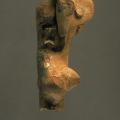
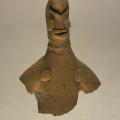
In addition to headdresses and hair decorations, loose hair is sometimes depicted on figurines. A few figurines have painted black hair extending from the back of the head to below the shoulders. Approximate dimensions (W x H x D): 3.9 x 5.2 x 2… >
In addition to different postures, male figurines also exhibit a variety of hairstyles. Both male and female figurines may have hair swept around the top of the head, to the side or to the front. A few male figurines also wear a sort of "torque" cho… >
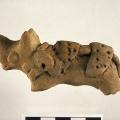
Although it was surely a wild animal, some of the rhinoceros figurines wear collars. While a collar might indicate domestication, it is unlikely that this is the case with the rhinoceros, although they may have been held as captives. Approximate … >
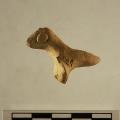
Several types of birds are represented in figurines. Bird figurines with long tapered tails probably represent parakeets. These birds often have flattened stylized feet that were attached to other terracotta objects such as cages of which there are … >
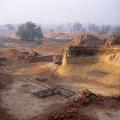
The central area of Mound A/AB was continuosly rebuilt in ancient times. Behind the curved wall is a well and below it what may have been a public bathing area. >
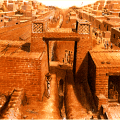
Photograph of gateway excavations, 1995. A series of side rooms were also excavated along the eastem edge of the gateway in 1995. The latest phase of construction also included a large east-west oriented doorway leading through the eastem edge of… >
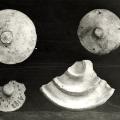
A number of miscellaneous objects emerged during excavations on Mound F, which contributed the majority of artifacts catalogued in the 1921 ASI report by Daya Ram Sahni. Among these were what he called lids and covers for crucibles – "shallow bowls … >
Published in Vats 1940, plate XCII, No 296. The published version is the other way up. Title: Seal Found in Mound AB. Vats noted the provenance as: “In squares P 18/11 and 12 are the remains of an oblong room measuring 14 by 12 ft. internal… >