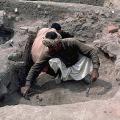
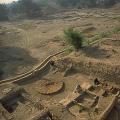
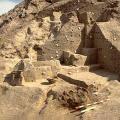
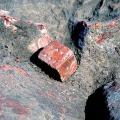
The circular platform excavated by Wheeler in 1946 (left) and the one excavated by HARP in 1998 (right). Both of these platforms were found inside small square rooms that originally had baked brick walls, subsequently removed by brick robbers (Trenc… >
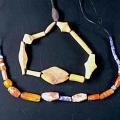
From different levels of the Ravi phase come these terracotta beads (center string) and hard stone beads made from carnelian, amazonite, and lapis lazuli. >
Excavations in 1996 revealed two Period 2 small kilns for making figurines and bangles, as well as preserved floors with Kot Diji style pottery, beads, and figurines >
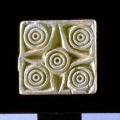
On this Kot Diji phase steatite button seal from Harappa (H2000-4495 / 9597-01), traces of blue-green glaze can be seen (upper center and left center). Similar seals have been found at other Kot Diji period sites and even in distant Central Asia. >
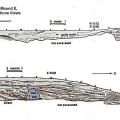
Cross-sections inside (top) and outside (bottom) of perimeter wall [250]. The wall itself, being of mud-brick, was heavily eroded, sometimes to a lower elevation than the adjoining more densely packed street debris. As can be seen in the bottom cros… >
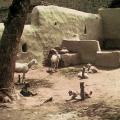
This courtyard of a modern house in Harappa town, has an upper level in front of the house that is plastered and has a small entryway that can be blocked to keep out animals. Drinking water is kept in earthenware pots on a wooden stand. The lower le… >
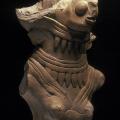
One of the largest female figurines found at Harappa has a (badly broken) fan-shaped pannier headdress with black residue in the cups of the panniers and a forward-projecting face. She is heavily ornamented with an elaborate choker and two other nec… >
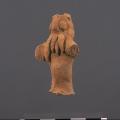
A few figurines are not clearly male or female, or even anthropomorphic or animal. One unusual recently discovered figurine has no clear sex characteristics. It does have two projections (broken off) that pointed forward from the back of the head as… >