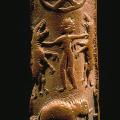
Plano convex molded tablet showing a female deity battling two tigers and standing above an elephant. A single Indus script depicting a spoked wheel is above the head of the deity. On the reverse (89), an individual is spearing a water buffalo wi… >
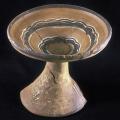
Pedestaled vessels such as this hand-built painted bowl-on-stand of the Ravi Phase appear to be the predecessors of a vessel form that becomes more common during the later Kot Diji and Harappa Phases. >
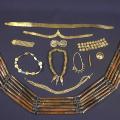
Fired steatite was an important material used in many different types of Indus jewelry. Steatite beads are found in all four necklaces in the center of this collection of jewelry from Harappa and Mohenjo-daro. >
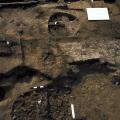
A large number of seals and inscribed objects were discovered in excavations on the eastern edge of Mound E from 1993 to 1997. This view of excavations in Trench 10W shows two rooms of houses along the edge of a north-south street. A square steatite… >
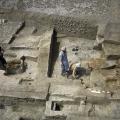
In 1998, the circular platform first exposed by Sir Mortimer Wheeler in 1946 was re-exposed and the area around the platform was expanded to reveal the presence of the room in which it was enclosed. The brick walls had been removed by brick robbers … >
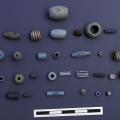
Faience beads of different shapes and colors were found in the bead pot (83). Some of these appear to be imitations of the natural stones; deep azure blue lapis lazuli, blue-green turquoise and banded to imitate banded agate. A red-brown glass-like… >
In what appears to have been an alley way between two blocks of buildings in Trench 54 was found a large pit filled with debris from pottery kilns. In the background is a room with a circular pit dug into it. >
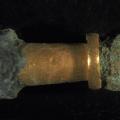
Composite gold bead with copper-alloy core or wire on interior. The corroded copper still covers part of the tubular gold bead. (H2000-4488/9829-01, Mound AB, Trench 43). >