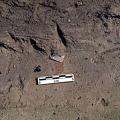
Along the eastern edge of the Kot Diji phase street on Mound AB at Harappa, a broken unfinished steatite seal was discovered in 2000 (close-up in 46 and 47). >
Overview of the north-south oriented brick wall (Feature 50) and doorway of the large Harappan building in Trench 39N. Note the earlier drain that runs east-west underneath the wall. >
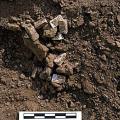
A group of 16 three-sided incised baked steatite tablets, all with the same inscriptions, were uncovered in mid- to late Period 3B debris outside of the curtain wall. (See 56). These tablets may originally been enclosed in a perishable container su… >
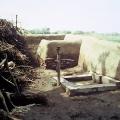
The bathing areas and walled latrine are located on the interior edge of the courtyard that touches the street. The drain from the bathinga area runs through the wall and falls directly into the street drain. Piles of firewood and an inverted cookin… >
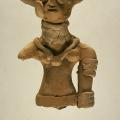
Some of the ornaments on female figurines were accentuated with white and/or black pigment, and some ornaments were completely rendered in pigment. One female figurine has a choker, a necklace, and bangles on the left upper and lower arm, all painte… >
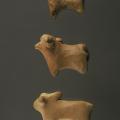
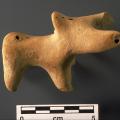
The earliest animal figurines from Harappa are Early Harappan (Ravi Phase, Period 1 and Kot Diji Phase, Period 2) zebu figurines. They are typically very small with joined legs and stylized humps. A few of these zebu figurines have holes through the… >
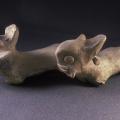
Other feline figurines with large round ears and beards may represent tigers or lions. They are often depicted either standing or lying down with their legs extended to one side. Approximate dimensions (W x H(L) x D) of the larger figurine: 3.3 x… >
Another figurine that may have been used as a toy is the quadruped, probably a bovine, with a movable head and tail. It usually has pierced projections extending from the base of the neck to secure the (separate) head and neck laterally and a pierce… >
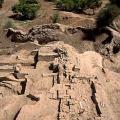
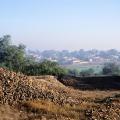
In the distance, the modern town of Harappa survives on another set of mounds. During ancient times they were separated from Mound AB in the foreground by a river channel. Archaeologists suspect that those mounds were also first settled in ancient t… >