Home

Main navigation

  • home
  • slides
  • essays
  • articles
  • books
  • video
  • q & a
  • blog
Secondary menu
  • about us
    • scholars
    • privacy
    • support
    • image rights
    • credits
    • contact us
  • resources

Harappa

Harappa, Punjab ancient Indus civilization excavations, figurines, seals and other objects.

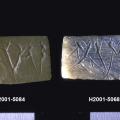
Inscribed steatite tablets

Inscribed steatite tablets made from two different colors of steatite have the same inscription. The sloppy nature of the inscription may be the reason why these tablets were discarded. Both tablets, incised on one side only, were found in the same … >

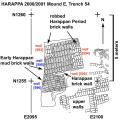
Harappan and early Harappan walls

Top plan view of Harappan (Period 3) and Early Harappan (Period 2) walls on the west side of Trench 54. >

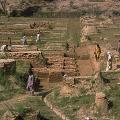
Excavations at the southeast corner of the "granary" structure

Overview looking north of excavations at the southeast corner of the "granary" structure undertaken in 1999 (Trench 1C). The higher east-west running walls in the left of the image and the ruined structures in the right of the image all post-date t… >

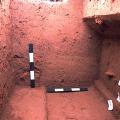
Looking toward the interior of the "granary" structure

Looking toward the interior of the "granary" structure, the void of the original baked brick wall (vertical scale) is filled with small pieces of broken baked bricks and mud-brick rubble, while the original open space between the walls (horizontal … >

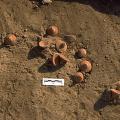
Detail of terracotta tops

Detail of terracotta tops found in Room 202 (Trench 43). >

Harappan Kiln

Period 4 (Late Harappan transitional) kiln with hollow lower fire box and arched floor with holes for allowing heat to enter the upper firing chamber. This type of kiln was introduced at Harappa ca. 1900 BC and allowed the potters to reach higher te… >

Discovering a broken unicorn seal.

While clearing a floor area in Trench 43, J. Mark Kenoyer discovers a broken unicorn seal. >

Ravi phase reed impressions

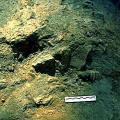
Ravi phase houses seem to have been constructed with wooden supports and walls made of plastered reeds. A lump of plaster with reed impressions is seen in this image. >

Agate drill tips

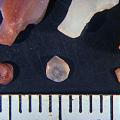
During drilling, the tips of agate drills become hot and often spall off. Fine screens allow the collection of the spalled drill tips, the finding of which confirms that drilling as well as shaping of beads was done in this area of the site during t… >

Basket impression and ceramic vessels

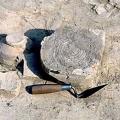
In preparing the basketry impression for removal, large numbers of broken Kot Diji phase ceramic vessels were uncovered, all discarded together into the street along with the basket. >

Pagination

  • First page
  • Previous page
  • …
  • Page 4
  • Page 5
  • Page 6
  • Page 7
  • Page 8
  • Page 9
  • Page 10
  • Page 11
  • Page 12
  • …
  • Next page
  • Last page
© Harappa.com 1995-2026 31