Home

Main navigation

  • home
  • slides
  • essays
  • articles
  • books
  • video
  • q & a
  • blog
Secondary menu
  • about us
    • scholars
    • privacy
    • support
    • image rights
    • credits
    • contact us
  • resources

HARP (Harappa Archaeological Research Project) a group of scholars from a variety of fields dedicated to advancing the study of the ancient Indus Valley civilization.

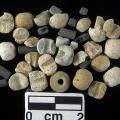
Stone beads

The beads in the top three rows of from the bead pot (83) were drilled with tapering holes, possibly with tubular drill or tapered cylindrical drill. The green beads are amazonite, banded agate, jasper. The rest are carnelian. The beads in the bo… >

Pottery sherds with potter's marks

The pit filled with kiln debris in Tench 54 had in it sherds from ceramic vessels with marks inscribed on their bases before firing and also from a flat inscribed disc or "bat" (at left) that was used as a removable base for throwing pottery on a po… >

Gold bead

Composite gold bead with copper-alloy core or wire on interior. The corroded copper still covers part of the tubular gold bead. (H2000-4488/9829-01, Mound AB, Trench 43). >

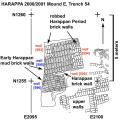
Trench 54 top plan

Overall Plan of Trench 54, showing the location of features noted in the previous slides. >

Newly discovered steatite tablet

Mohammad Sahmoon (left) and Saeed Ahmad with newly discovered steatite tablet and raw steatite block from Trench 54 South. >

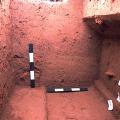
Harappan walls section view

Section plan of Harappan and Early Harappan (Period 2) walls on the west side of Trench 54. >

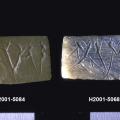
A broken steatite tablet

A broken steatite tablet (H97-3431/7615-01) was recovered from deposits just below the fired brick revetment of the "granary" platform and dates to Harappa Period 3B (2450-2200 BC). >

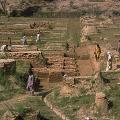
Excavations conducted in narrow space

Excavations were conducted in the narrow space running west from the buttresses and between the interior walls to determine what was inside of the "granary" structure. >

Mound F Harappa Section drawing

Section drawing of the cut through the Mound F city wall and adjoining interior street, facing east (Trench 41NE). >

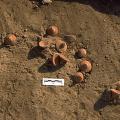
Collections of broken pottery

Excavations in Trench 43 revealed collections of broken pottery that date to the final phases of the Harappan occupation of Period 3C, ca. 1900 BC. Note the antler piece (image 58) to the right of the broken dish. >

Pagination

  • First page
  • Previous page
  • …
  • Page 28
  • Page 29
  • Page 30
  • Page 31
  • Page 32
  • Page 33
  • Page 34
  • Page 35
  • Page 36
  • Next page
  • Last page
© Harappa.com 1995-2026 31