HARP (Harappa Archaeological Research Project) a group of scholars from a variety of fields dedicated to advancing the study of the ancient Indus Valley civilization.
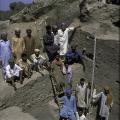
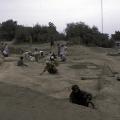
J. Mark Kenoyer (top center, arm outstretched) and excavation team gather at the edge of Trench 39 South at the end of the excavation season. Over the past twelve years many of the local workmen from Harappa and surrounding villages have become extr… >
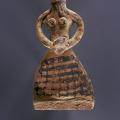
Early Harappan female figurine holding a bowl in her two hands. The face is painted with bold eyes and a necklace with pendant beads is painted at the throat. The lower body is decorated with cross hatched painted design that may indicate the patter… >
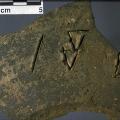
This fragment of a mold used for making large storage jars has three pre-firing graffiti signs. Such symbols when combined together may have served to indicate the name of the owner rather than just being abstract symbols. This piece dates to the en… >
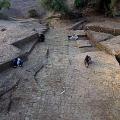
Clearing the ancient Harappan debris from the eroded surface outside of the mud brick city wall at the eastern edge of Mound E. In 1997 this area of Trench 11 was cleared to define the stratigraphic sequence between Period 3B and 3C. It was possible… >
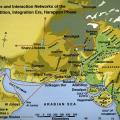
This map shows the networks that connected urban centers such as Mohenjo-daro and Harappa during the Harppan Period (2600-2000 BC) with their hinterlands and distant resource areas.In addition to these two cities, other known urban centers include D… >
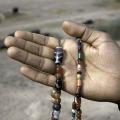
This collection was found from the eroding surface of Bawani, a site not far from Harappa that dates from the 3rd century BC. The red brown beads are glass beads of the Early Historic Period showing a continuity with the glazing technology of red fa… >
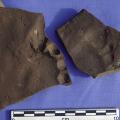
Flat, uneven, pottery discs used as baffles in the firing process were found in the pit with kiln debris from Trench 54 (slide 12). Two of these, broken during the firing of the kiln, bear the foot prints of small children. Pottery manufacture durin… >
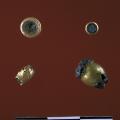
A collection of gold beads, three of which (UL, UR, LL) have copper-alloy in their interiors. The corroding copper often breaks the softer gold foil (Mound E, Trench 54). >