Home

Main navigation

  • home
  • slides
  • essays
  • articles
  • books
  • video
  • q & a
  • blog
Secondary menu
  • about us
    • scholars
    • privacy
    • support
    • image rights
    • credits
    • contact us
  • resources

Harappa Archaeological Research Project

HARP (Harappa Archaeological Research Project) a group of scholars from a variety of fields dedicated to advancing the study of the ancient Indus Valley civilization.

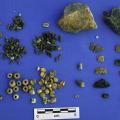
Group of artefacts

  • Group of artifacts

Artifacts found in one excavation unit from the Trench 54 South workshop include raw steatite, sawn blocklets, incised tablets, a broken mold, and numerous faience beads as well as faience tablets. Also note the chert blade and flake (upper left) th… >

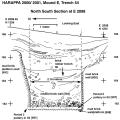
Section view of walls and platforms

  • Section view of walls and platforms

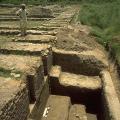
North-South section plan of Harappan (Period 3) and Early Harappan (Period 2) wall remnants and mud brick platforms on the west side of Trench 54. >

The northwest corner of the "granary" platform

  • The northwest corner of the granary platform

Excavations in 1997 at the northwest corner of the "granary" platform were undertaken to follow the outline of the structure and document its construction (Trench 1NW)). >

Empty channel between two "granary" walls

  • Empty channel between two granary walls

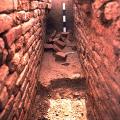
This image looking east shows baked brick rubble and trash that had spilled through the corbelled arch of a buttress from the exterior street into a then empty channel between two "granary" walls. >

Overview of the upper levels of the excavations

  • Overview of the upper levels of the excavations, Harappa

Overview of the upper levels of the Trench 43 excavations in 1999 shows the eroded city wall in the background and the fallen baked brick walls of late Period 3C structures in the foreground. >

Late Harappan Vessel

  • Late Harappan Vessel

One of the falling walls in Trench 43 crushed a vessel that belongs to Harappa Period 4 (ca. 1900-1800/1700 BC). In this part of the mound, there appear to be transitional levels between the Harappan and Late Harappan periods. >

Male figurine

  • Male figurine

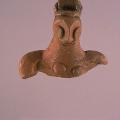
Male figurine (H2000-4974/9845-01) from Trench 43. >

Harappa, Mound AB

  • Harappa, Mound AB

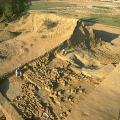
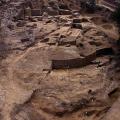
The northern end of Mound AB, shown here from the North, comprises more than 17 meters of occupational debris beginning on top of an old levee of the river Ravi and continuing up from the Ravi [Aspect of the Hakra] phase (Period 1 from before 3300 t… >

Ravi phase microdebitage

  • Ravi phase microdebitage

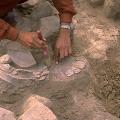
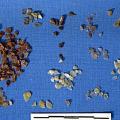
After wet screening, the Ravi phase microdebitage, larger flakes, broken drills, and even microbeads are sorted according to type of artifact and kind and color of stone. >

Kot Diji phase raw materials

  • Kot Diji phase raw materials

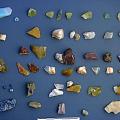
During the Kot Diji phase many new types of raw material were brought to Harappa for making ornaments and tools, indicating expanded trade networks and suggesting a growing population of consumers. A wide variety of stones reflecting different stage… >

Pagination

  • First page
  • Previous page
  • …
  • Page 25
  • Page 26
  • Page 27
  • Page 28
  • Page 29
  • Page 30
  • Page 31
  • Page 32
  • Page 33
  • …
  • Next page
  • Last page
Unicorn Seal, Mohenjo-daro
© Harappa.com 1995-2026 31