HARP (Harappa Archaeological Research Project) a group of scholars from a variety of fields dedicated to advancing the study of the ancient Indus Valley civilization.
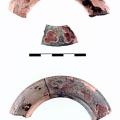
Terracotta bangle fragments decorated with red trefoils outlined in white on a green ground from late Period 3C deposits in Trench 43. This image shows both sides of the two fragments (H98-3516/8667-01 & H98-3517/8679-01). >
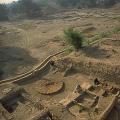
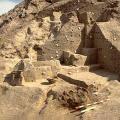
The circular platform excavated by Wheeler in 1946 (left) and the one excavated by HARP in 1998 (right). Both of these platforms were found inside small square rooms that originally had baked brick walls, subsequently removed by brick robbers (Trenc… >
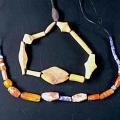
From different levels of the Ravi phase come these terracotta beads (center string) and hard stone beads made from carnelian, amazonite, and lapis lazuli. >
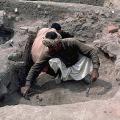
Excavations in 1996 revealed two Period 2 small kilns for making figurines and bangles, as well as preserved floors with Kot Diji style pottery, beads, and figurines. >
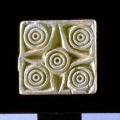
On this Kot Diji phase steatite button seal from Harappa (H2000-4495 / 9597-01), traces of blue-green glaze can be seen (upper center and left center). Similar seals have been found at other Kot Diji period sites and even in distant Central Asia. >
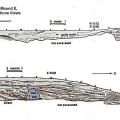
Cross-sections inside (top) and outside (bottom) of perimeter wall [250]. The wall itself, being of mud-brick, was heavily eroded, sometimes to a lower elevation than the adjoining more densely packed street debris. As can be seen in the bottom cros… >
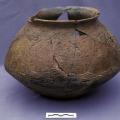
Cooking pots during the Ravi Phase were made in large globular shapes that had a low center of gravity to keep them from tipping over when filled with food. In order to protect the fine clay from cracking due to the heat of the fire, the exterior wa… >
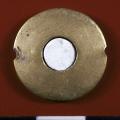
Fired steatite beads appear to have been extremely important to the Indus people because they were incorporated into exquisite ornaments, such as this "eye bead" made of gold with steatite inlay found in 1995 at Harappa [Harappa Phase]. >