HARP (Harappa Archaeological Research Project) a group of scholars from a variety of fields dedicated to advancing the study of the ancient Indus Valley civilization.
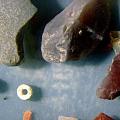
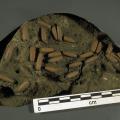
Tiny steatite microbeads (less than 1mm in diameter) such as those seen here were probably perforated with a sharpened copper wire, while stone drills with larger tips were used for carnelian, lapis, and amazonite beads. >
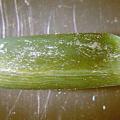
This unique green stone bead, hardly 1 cm long, was found in the ash at the edge of a Kot Diji phase hearth. The material has not yet been identified, but it may be a form of obsidian. >
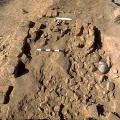
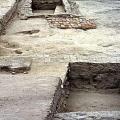
A paving of brick rubble and broken ring stones, dating to late in the Harappa phase, was found on top of Mound AB to the west of the wall void shown in 50. >
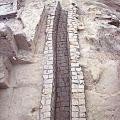
Brick robbing from both directions removed all but the central portion of this drain, but the remaining contents provide an important sequence of Harappan pottery spanning at least 200 years from 2400-2200 BC. >
In the South, perimeter wall [250] was preserved to a lesser altitude than in the North. In the very south of the area excavated in 1996, the lower portions of the walls of a mud-brick room were found attached to the inside of the perimeter wall nex… >
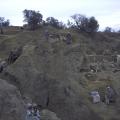
Excavations on Mound AB in 1998 began with the clearance of surface debris to expose the many habitation levels, beginning with natural soil in the lower foreground. This view shows almost 1700 years of superimposed occupation levels beginning aroun… >
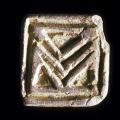
This fired steatite button seal from the Kot Dijian Phase (Period 2, 2800-2600 BCE) shows a unique pattern that may be an early form of the Harappan script sign that may represent "house" or "temple." >
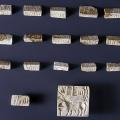
Sixteen three sided tablets (c. 2300 BCE) with incised inscription on each face were found all together in the debris that had been dumped over the curtain wall (54). On one of the three sides is an inscription that is identical to the last two sign… >
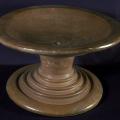
Late Harappan Period Dish-on-stand from Harappa with a hole in the center of the dish that may have been used for a special ritual purpose. The dish is pedestaled on a heavy base with triple ridges. This unique form of vessel was found at the foot o… >