HARP (Harappa Archaeological Research Project) a group of scholars from a variety of fields dedicated to advancing the study of the ancient Indus Valley civilization.
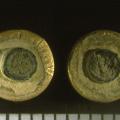
These two gold bead were originally part of the same ornament. Thin gold foil was placed over the outside of a sandy core around a copper tube (H2000-4382/2087-02, Mound E, Trench 54). >
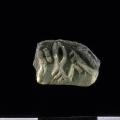
This uniquely shaped tablet (H2001-5090/2913-09), also made with two colors of faience, has an inscription similar to that seen on the previous slide (67). This tablet was found inside the workshop in Trench 54 South. >
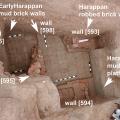
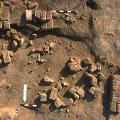
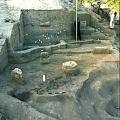
Overview of the excavations showing the Harappan (Period 3) and Early Harappan (Period 2) walls on the west side of Trench 54. North is to the right. >
Section through the northwestern portion of the "granary" platform directly below the baked brick "granary" walls (Trench 1NW). Similarity of composition of the mud-bricks in the northwestern, southwestern, and southeastern parts of the "granary" pl… >
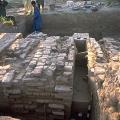
After clearing an interior area in the southeast part of the "granary", it became evident that the inner baked brick wall of the original structure had been dismantled by the ancient Harappans before they filled in the resulting void and built the o… >
After removing the fallen walls, the interiors of the rooms were found to be filled with surprises. Here in Room 202 were scattered clay tops, beads, and inscribed seals (Trench 43). >
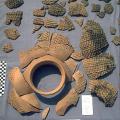
This Period 4 globular pot (H99/8763-503) was found crushed beneath a fallen wall in Trench 43 (see image 59). The rough textured exterior was covered with a thick layer of blackened clay that indicates it was a type of cooking pot and not for water… >
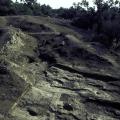
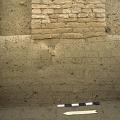
View of Harappa Mound AB Trench 39N from the North showing the earliest Ravi [Aspect of the Hakra] phase occupation levels (Period IA, ca. 3300 BC). These levels revealed traces of post molds from houses that were oriented N-S/E-W. >