HARP (Harappa Archaeological Research Project) a group of scholars from a variety of fields dedicated to advancing the study of the ancient Indus Valley civilization.
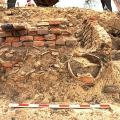
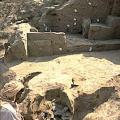
In the upper levels of , a small baked brick structure with sump pots was found. This structure, possibly a latrine, is on the northern margin of a major east-west street that ran along the southern edge of the "granary" area. It dates to late in Pe… >
Detail view of the fill inside the "granary" buttress. Large pottery sherds, bone, and baked brick fragments lie on the bottom with finer silts on the top >
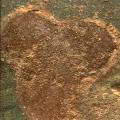
Detail of terracotta bangle with red and white trefoil on a green background (H98-3516/8667-01 from Trench 43). Trefoil motifs are carved on the robe of the so-called "priest-king" statuette from Mohenjo-daro and are also known from contemporary sit… >
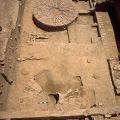
Detail view of the HARP-excavated platform in Trench 43 with Wheeler's platform to the east (toward the top of the image). Note the mud-brick wall foundations that surround each platform to the east, south, and west (the north walls remain unexposed… >
Ravi phase microbeads of lapis lazuli (top row), amazonite, and carnelian (bottom row) indicate the size and nature of the drills used for perforation. The largest of the illustrated beads is less than one centimeter in diameter. >
Along the eastern edge of the Kot Diji phase street on Mound AB at Harappa, a broken unfinished steatite seal was discovered in 2000 (close-up in 46 and 47). >