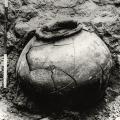
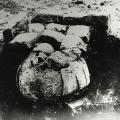
"It was at this point that the large earthen jar (No. A 233 of the list and photo. No. 2741) came to light. The contents of this vessel were a number of domestic earthenware utensils, a stone chess figure, etc." - Daya Ram Sahni, Annual Prog…>
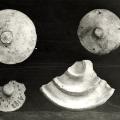
A number of miscellaneous objects emerged during excavations on Mound F, which contributed the majority of artifacts catalogued in the 1921 ASI report by Daya Ram Sahni. Among these were what he called lids and covers for crucibles – "shallow bowls … >
Published in Vats 1940, plate XCII, No 296. The published version is the other way up. Title: Seal Found in Mound AB. Vats noted the provenance as: “In squares P 18/11 and 12 are the remains of an oblong room measuring 14 by 12 ft. internal… >
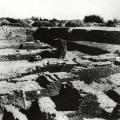
Published in Vats 1940, Vol. II, Plate XXXIV (d). Title: ‘Pit III Fragmentary Remains, from North-West’. Of Pit III in Mound AB Sahni noted: “Four large pits, each 50' square, were sunk simultaneously in a line in the southern portion of mo… >
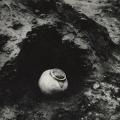
A (e) 308 earthen jar lying to the east of earlier sepulchre in trench A (e). A jar insitu. For Sahni’s description of trench A (e) in Mound F, and its contents, see ARASI 1924-25, pp. 75-76. There is no mention of this eart… >
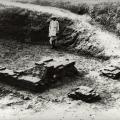
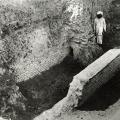
The section above the wall shows the remains of a deep pit left by the brick robbers. Often when the digging got too deep, they just abandoned the removal of bricks and left the lowest levels of the wall intact. The workman is standing next to a cro… >
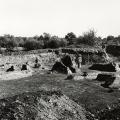
"In January 1921, Rai Bahadur Daya Ram Sahni sank in the north-western part of this mound the diagonal Trench A, 16 ft. wide and 500 ft. long from south-east to north-west, starting from the centre of the mound and reaching almost to its north-weste… >
For Sahni’s description of the excavations at the area of the ‘parallel walls’ see ARASI 1924-25, pp. 76. The walls were both, stouter and thinner. Sahni mentioned that ‘the upper portion [of the former] is built solidly of burnt bricks,… >
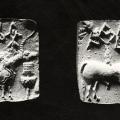
These two sealings are labelled 1917-1920 in the ASI archives. They come from Punjab volume 26, earlier than the full 1921 excavation images which were in volumes 27 and 28. Why 1917? In the absence of more information it is hard to say much except … >