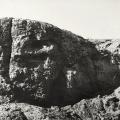
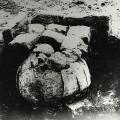
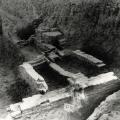
"A second trench was started in the western portion of this mound, but I was so completely bewildered by the enormous accumulations of earth that had to be cleared away that it appeared futile to continue it at the present stage." At this point S… >
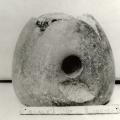
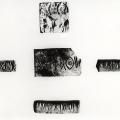
The object published in ARASI 1924-25, Plate XXVII (h) The object has been photographed from a distance in this, in comparison to the published photograph. The scale in front and a rod/scale at the back of the object is visible in both p… >
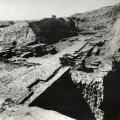
Published in ARASI 1924-25, Plate XXVI (c). Title: ‘Harappa: Mound B, Pit IV, A Rectangular Cell Crossed by a Drain’. “The fourth trench or the northernmost pit revealed the remains of several structures, the best preserved one of which … >
The excavations on mound A-B revealed several strata of inhabitation with walls, platforms and drains indicated. Several objects were unearthed in these strata. These two photographs show the same view, with first a wider angle of the site, and then… >
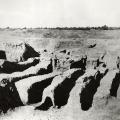
"The sites F and A-B and some of the other mounds bid fair to yield many more valuable relics and the deep ravines cut by rain water afford convenient places for reaching the earlier strata with comparatively little trouble. One of these ravines imm… >
View of six parallel walls, of the “stouter kind”. Sahni: “The most important architectural discovery … of the year was made about the centre of this mound which, though only partially, exposed, already embraces an area of 106' from east to west … >
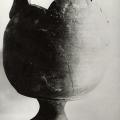
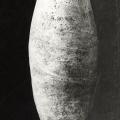
This form of tall flaring cylindrical vessel was probably used as a drinking vessel. Seven of these tall jars (referred to as oval jars) were found in a row and many had smaller cylindrical jars inside them. It is possible they were being stored in … >
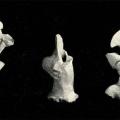
Daya Ram Sahni quickly recognized the preponderance of female figurines; after describing the two male figurines found, he writes: "All the other human figures are female figures (Plate X, Photo. No, 2807-b) which appear to be crude cari… >