Home

Main navigation

  • home
  • slides
  • essays
  • articles
  • books
  • video
  • q & a
  • blog
Secondary menu
  • about us
    • scholars
    • privacy
    • support
    • image rights
    • credits
    • contact us
  • resources

Daya Ram Sahni

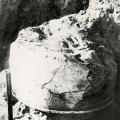
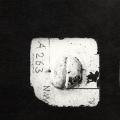
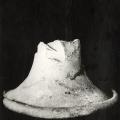
Top of a Colossal Clay Jar

Whether or not this was one of the first objects discovered in Trench A, given the catalogue number 2, is unclear, but it was unusual to Daya Ram Sahni who said he had not seen something of the sort before, with an opening over a foot across. About … >

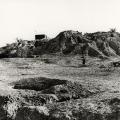
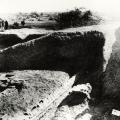
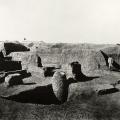
Mound AB General View from the North

Next to the excavations on Trench A, Mound F, in 1921 Sahni also cut into Mound AB, under the remnants of a mosque that once stood on top of the mound and the tomb of a holy man which still stands and is visited today. "Of the mound marked A, B, … >

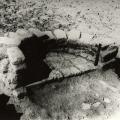
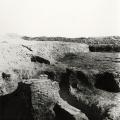
Excavation Pit I Drain

View of Pit I, Mound B, with the long, gabled roof drain. The area of Pit I is marked with a label in the photograph and two men positioned in two areas to show the salient features. One stands near the cell like structures, of bricks. Sahni: “Fo… >

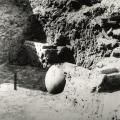
Earthen Jar Trench A

Earthen jar placed inside down along west edge of the southern portion of trench A (e). Is this the same jar as the Large Earthen Jar? Both were found with their mouth (this case, inside) down. Sahni described the jars as “cinerary”: “What the… >

Circular Hearth Harappa

Circular Hearth in eastern portion of trench A (f) from S.E. There is no mention of a circular granary from trench A(f), Mound F, in ARASI 1924-25. However, Sahni noted “two little circular structures paved in brick on a thick substratum of hard … >

Fragmentary Globular Jar

Fragmentary earthen jar P.II 38. Pit II. A large earthen jar broken at the shoulder insitu, next to a structure. >

Three Seals [Backs], Harappa

"The discovery at Harappa of the very remarkable seal illustrated in figure 1 of Cunningham's Plate XXXIII in this volume [see Image 2 above] and later of a few more now in the British Museum, suggested that at this site we have the remains of a cit… >

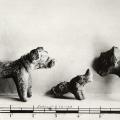
Terracotta Animal Figurines

"Animal figures, mostly in terracotta, have been found in very large numbers at Harappa. They are also fairly common in faience, specially the squirrels and rams, both of which were used as amulets. More rarely, they were made of steatite, shell and… >

Pit Containing Well

Possibly the “narrow well” with the “steaning wall” only 11 inches thick, in Mound F trench A (e), which Sahni reported from the lowest excavated strata, and which he inferred was connected to the “reservoir” excavated in 1923-24: “In mound F whi… >

Harappa Walls

A view of a part of the area of Parallel walls, Mound F, possibly before deep digging. One thinner wall is exposed, and traces of the others visible. NOTE: Photos Block of Parallel Walls, Block of Parallel Walls and Harappa Walls are of the area … >

Pagination

  • First page
  • Previous page
  • …
  • Page 9
  • Page 10
  • Page 11
  • Page 12
  • Page 13
  • Page 14
  • Page 15
  • Page 16
  • Page 17
  • Next page
  • Last page
© Harappa.com 1995-2026 31