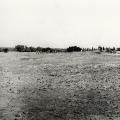
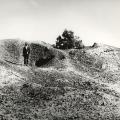
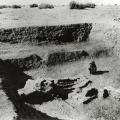
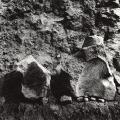
"The mound was covered with potsherds and brick bats, but no brick foundations were visible anywhere that might have served as a starting point." - Daya Ram Sahni, Annual Progress Report of the Archaeological Survey [of India], Hindu and Budd…>
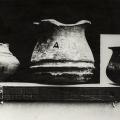
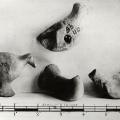
Three more examples, all from Mound F, of what Daya Ram Sahni immediately identified as inkpots. "The other portable antiquities recovered in this Mound F, though not numerous, all point to a high antiquity. A number of terracotta figurines were … >
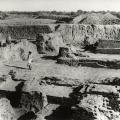
In the 1923-24 season, Trench A(b) was one of the extensions dug by Daya Ram Sahni from the centre of Trench A in Mound F. Sahni describes the parallel walls in his report of the season's excavations. Artifacts found in A(b) are listed by Vats in hi… >
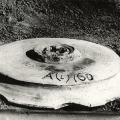
Cover of a jar, Terracotta, field number A(i) 160. Of trench A (i) in Mound F, Sahni: “The trench Ai (100' x 31') excavated to the east of the one described above [A (e)] revealed at the depth of 5' a large mass of earthen bowls with pointed base… >
Sink for collection of water in the form of an earthen jar with channel cut out of a brick. A jar, numbered A (f) 160,insitu. Sahni mentions a large earthen jar near a bathing platform in Trench A (f), near the circular structures: “… >
Sahni mentioned the highest mound at Harappa to be ‘the summit of the northern portion of Mound B”. This is one of the views of this portion, with a person, wearing glasses, standing. Of ‘brick-robbing’ at Harappa in the modern times, John Marsha… >
"Animal figures, mostly in terracotta, have been found in very large numbers at Harappa. They are also fairly common in faience, specially the squirrels and rams, both of which were used as amulets. More rarely, they were made of steatite, shell and… >
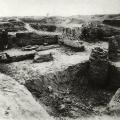
This is a photograph of the same area as in Slide 7, Trench A (e) (Vats 1947, Plate IX), but taken from the northeastern edge of the trench looking north. It shows the excavation of the exterior of the well and many of the fragmentary walls have bee… >
A view of excavations at Trench A (i), Mound F. Deep vertical cutting, mark the sides of the trench, and a labourer is shown, sitting close to the finds of structures, of bricks For a description of the excavations and the finds, including of, th… >
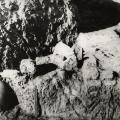
The back of two stone pieces in Stone Objects. Possibly the two blocks of grey and red sandstones, B. 1514 and B. 1515 (cf. ARASI 1924-25, p. 79) B.1515 was noted by Vats as “carved somewhat in the shape of a tortoise shell” (Vats 194… >