Home

Main navigation

  • home
  • slides
  • essays
  • articles
  • books
  • video
  • q & a
  • blog
Secondary menu
  • about us
    • scholars
    • privacy
    • support
    • image rights
    • credits
    • contact us
  • resources

Homes

Posts about ancient Indus Valley Civilization homes and houses.

Harappa Mound AB Center

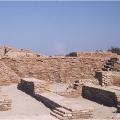
Harappa Mound AB Center with the great drain looking out over Punjab. Harappa was first excavated in 1872 by Alexander Cunningham, the original Director General of the Archaeological Survey of India. Although he named the mounds and found a seal and other implements after digging a handful of trenches, he was in search of a Buddhist city and did not realize that he had come upon a Bronze Age civilization that would push back Indian history 2,000 years. It took until 1921 before Harappa was excavated again by Daya Ram Sahni (inset shows unexcavated mound that year), but even then, it was not u… >

Mohenjo-daro 50 Years Ago in 6 Images

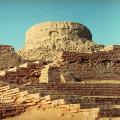
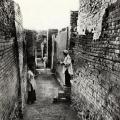
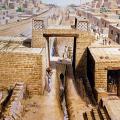
Mohenjo-daro 50 Year Ago in 6 shots. A long view towards the Great Bath, the Great Bath, a narrow street, a street with a covered drain, a photographer at the site, and the Stupa Mound, all in 1962. See also Urban Construction of Mohenjo-daro. >

An Indus House #1

"House 13 in the VS Area [of Mohenjo-daro] has a more elaborate plan . . . On its ground floor are four fair-sized courts, ten smaller rooms, three staircases, a porter's lodge, and a well-chamber. The front is towards First Street, and here there are three entrances side by side, the principal one of which is plainly the middle, since this is the only one provided with a porter's lodge. ... Entering the house by the main door one finds oneself in a small vestibule (Room 68), with a porter's lodge to the right and a second doorway directly opposite leading to the open Court 67. A feature of t… >

Urban Construction of Mohenjo-daro

  • Mohenjo-daro

A rarely seen image of deep diggings at Mohenjo-daro in 1950 gives some sense of the density of urban construction in the city. This is in the citadel area, with the so-called Great Granary or large hall in the background, "gradually engulfed by a clutter of later Indus buildings," although we do not know the stratigraphic relationship between these buildings and the large hall. This is close to the Great Bath, off-screen to the left. The two circular structures are wells. (From F.A. Khan, The Indus Valley and Early Iran, 1964, Plate III) >

An Indus House #2

Drawing of the Interior of Hall 76, House XIII, VS Area [of Mohenjo-daro], one of 28 rooms in a well-preserved building. "There is nothing that we know of in prehistoric Egypt or Mesopotamia or anywhere else in western Asia to compare with the well-built baths and commodious houses of the citizens of Mohenjodaro" wrote John Marshall. "One of the finds from this [room] consisted of fragments of a pierced lattice of alabaster which presumably filled the windows or ventilators at the top of the wall" (Marshall, Mohenjo-daro Vol. 1, pgs. vi, 219). See also An Indus House #1 and An Indus House … >

Granary Excavations Reveal New Facts

  • Plan view of the so-called "granary" or "parallel-wall structure" on Mound F at Harappa indicating areas of HARP excavations conducted in 1997 and 1999. Note that the structural remains surrounding the "granary" are, for the most part, later than the original "granary" structure.

Excavations at the "Granary," Harappa, Trenches 41 exposed new facts about this most puzzling of structures. Built apparently at one time, and more than once reconstructed on the foundations of a previous structure, there is absolutely no sign of grain in the rooms or hollow areas between them. >

Pagination

  • First page
  • Previous page
  • Page 1
  • Page 2
  • Page 3
  • Page 4
Blog Posts by Subject (16)
  • Animals
  • Art
  • Children
  • City Life
  • Conferences
  • Crafts and Industry
  • Evolution
  • Excavations
  • Food
  • Homes
  • Media
  • Museums
  • Mysteries
  • News
  • People
  • Seals
© Harappa.com 1995-2026 31