Home

Main navigation

  • home
  • slides
  • essays
  • articles
  • books
  • video
  • q & a
  • blog
Secondary menu
  • about us
    • scholars
    • privacy
    • support
    • image rights
    • credits
    • contact us
  • resources

Homes

Posts about ancient Indus Valley Civilization homes and houses.

An Indus House #3

"One of the finds from the former room [13] consisted of fragments of a pierced lattice of alabaster which presumably filled the windows or ventilators at the top of the wall. Perforated screens with geometric patterns have been met with before in Kushan and Gupta buildings. It is now patent that perforated lattices were known and employed in the Indus valley in the prehistoric period," (Marshall, Mohenjo-daro, Vol. 1, 1931, p. 219). See also An Indus House #1 and An Indus House #2. >

Mohenjo-daro Great Bath Diagram

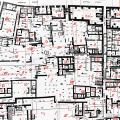
"The Great Bath, which I have reserved to the last, was part of what appears to have been a vast hydropathic [water therapeutic] establishment and the most imposing of all the remains unearthed at Mohenjo-daro. Its plan is simple: in the centre, an open quadrangle with verandahs on its four sides, and at the back of three of the verandahs various galleries and rooms; on the south, a long allery with a small chamber in each corner; on the east, a single range of small chambers, including one with a well (no 16); on the north, a group of several halls and fair-sized rooms. In t… >

Mohenjo-daro: Narrow Streets and Lanes

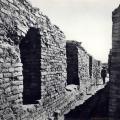
Buildings and streets were aligned along a north-south and east-west grid with minor variations introduced as new buildings were constructed. The corbeled arch in the background was built to cover a street drain, but was eventually blocked as the cross streets were filled with debris. See also First Street of Mohenjo-daro: Revisited. >

Stairways of Mohenjo-daro II

In addition to hundreds of wells, Mohenjo-daro would have had hundreds of staircases. Many houses had stairs leading to upper courtyards of the building or to a second floor. This house in HR area had a double staircase that would allow people to enter and exit the upper courtyard in an orderly fashion. Some scholars feel this may have been a palace or a temple. Two doorways lead to a narrow courtyard at a lower level. >

The Silent Lanes of Mohenjo-daro

1. The Stupa Mound, Mohenjo-daro, 1962. 2. Low Lane, East of Blocks 4 and 7. Inter. III Level. From North. "Low Lane, 4 ft. 10 ins. wide at the Intermediate III level; in the photograph of this lane, the eastern side of Block 4 is seen between the two men." 3. "Crooked Lane" South of Blocks 4 and 5, DK Area, G Section. This was excavated by Ernest Mackay, who wrote "Fore Lane along the north of this building was 5 ft. wide at the Intermediate III Level [about 20 feet below ground]. There is some uncertainty about the alignment of the foundations of the building seen on the left in thi… >

Low Lane, Mohenjo-daro

"With the exception of First Street, the most impressive thoroughfare in the DK Area, Southern Portion," writes the early excavator of Mohenjo-daro, Ernest J.H. Mackay, "is unquestionably Low Lane which runs practically parallel with it. This is chiefly because the depth to which it has been excavated and its narrow width increase the apparent height of the houses on either side. But the street has preserved its character and identity from the Intermediate III (XVI., 2.) onwards to the Late I Phase (Pl. XX). The facades of most of the houses as far as the northern limit of Block 6 ar… >

Artistic Reconstruction of Harappa

One of the most detailed reconstructions of an ancient Indus gateway, this one on Mound E at Harappa. The reconstruction was drawn by Chris Sloan, based on the work done by the Harappa Archaeological Research Project. J.M. Kenoyer writes: "A series of side rooms were also excavated along the eastern edge of the gateway in 1995. The latest phase of construction also included a large east-west oriented doorway leading through the eastern edge of the gateway. This doorway appears to have constructed with wooden beams with a threshold embedded in the baked brick structure.The size of these beams … >

Impressions of Indus Life around a Well

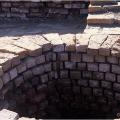
Excavator Ernest Mackay wrote of this well-head in Mohenjo-daro: "Brick lined wells are a common feature, most of the larger buildings and houses having their own, to which the poorer people frequently had access. In the early days of the city it is probably that some of the wells were quite private, as their seems to be no means of reaching them from the street, but later on, as the population grew, they were thrown open to public use. The rooms within which the wells were situated were, as a rule, carefully paved, and the floor in many cases was marked with deep depressions where countless … >

Mohenjo-daro Restaurant?

Was this an ancient Mohenjo-daro restaurant? Sir Mortimer Wheeler writes "Of another kind is a building fronting upon one of the main streets, 'First Street', in VR Area [Mohenjo-daro]. Its outside dimensions are 87 by 64.5 feet, but within that considerable framework are included not only residential quarters around the courtyard but also, towards the street, industrial or commercial premises of some note: in particular, three rooms neatly paved with bricks on edge, one room with five conical pits or holes sunk in the floor and lined with wedge-shaped bricks, apparently to hold the pointed b… >

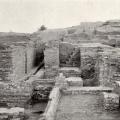
The Harappan Bathroom

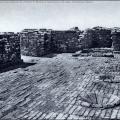
"The bathroom itself was usually a small square or rectangular room with a carefully-laid brick pavement sloping towards one corner. In this corner was the outlet for the water, which, in some cases also ran through the latrine." >

Pagination

  • Page 1
  • Page 2
  • Page 3
  • Page 4
  • Next page
  • Last page
Blog Posts by Subject (16)
  • Animals
  • Art
  • Children
  • City Life
  • Conferences
  • Crafts and Industry
  • Evolution
  • Excavations
  • Food
  • Homes
  • Media
  • Museums
  • Mysteries
  • News
  • People
  • Seals
© Harappa.com 1995-2026 31