Home

Main navigation

  • home
  • slides
  • essays
  • articles
  • books
  • video
  • q & a
  • blog
Secondary menu
  • about us
    • scholars
    • privacy
    • support
    • image rights
    • credits
    • contact us
  • resources

Art

Blog posts about the art of the ancient Indus Valley Civilization.

Manufacturing Faience Tablets

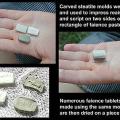
First it is necessary to make the faience paste and the steatite molds. Then the paste is formed into a rectangle and impressed on both sides by the molds. Finally the molded tablets must be dried slowly with air flowing on all sides to allow efflorescence of the glazing flux that is mixed with the faience paste. See also Reconstruction of Faience Tablet Manufacturing or see more images in Harappa 2000- 2001 slideshow. >

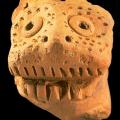
Harappan Feline Figurine

An Indus feline figurine from Harappa. Among the dangerous wild animals represented in the figurine corpus are large wild felines. This feline figurine with punctuate designs on the face (possibly representing spots) and an open mouth showing teeth is a relatively naturalistic representation of a large wild cat, possibly representing a leopard or a cheetah. Approximate dimensions (W x H(L) x D): 4.6 x 11.5 x 6.2 cm. Photograph by Richard H. Meadow. For another feline face, see also Ritual Mask or Amulet. >

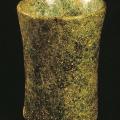
Fuchsite Drinking Glass

  • A drinking glass with finely polished exterior surface and sparkling internal crystal facet.

Mark Kenoyer writes: "One famous stone vessel found at Mohenjo-daro is a tall glass with concave sides that is similar in shape to ritual columns found in Balochistan and Afghanistan. This green stone, called fuchsite, is rare, but it can occur with quartzite which is common throughout Balochistan and Afghanistan. When this fuchsite vessel was first examined by a geologist in the 1930's, the only know source was Mysore State, over 1600 km south of the Indus Valley. Early scholars suggested that the stone was brought to the Indus cities from the south along with gold and ivory, but both of the… >

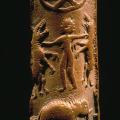
Deity Strangling Tigers Tablet

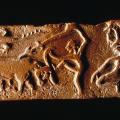
Planoconvex molded tablet from Harappa showing a deity battling two tigers. "The thick jungles of the Indus Valley were full of tigers and leopards, so it is not surprising that the image of a ferocious feline is a recurring motif in ritual narratives on seals as well as molded tablets... The figure strangling the two tigers may represent a female, as a pronounced breast can be seen in profile. Earlier discoveries of this motif on seals from Mohenjo-daro definitely show a male figure, and most scholars have assumed some connection with the carved seals from Mesopotamia that illustrate episode… >

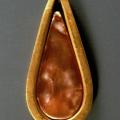
Carnelian and Gold Pendant

"Numerous inlaid shapes, such as droplets or circles, have been found at both Mohenjo-daro and Harappa," writes Dr. Mark Kenoyer, "but we did not know how these were incorporated into ornaments until we discovered a complete pendant at Harappa in 1987." >

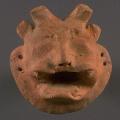
Ritual Mask or Amulet

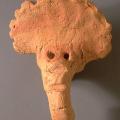
Loosely included under the rubric of terracotta "figurines" are the terracotta masks found at some Harappan sites. This mask clearly has a feline face with an open mouth with exposed fangs, a beard, small round ears and upright bovine horns. It is small and has two holes on each side of the face that would have allowed it to be attached to a puppet or worn, possibly as an amulet or as a symbolic mask. The combination of different animal features creates the effect of a fierce composite animal. As an amulet or a symbolic mask, it may represent the practice of magic or ritual transformation in … >

Dancing Girl Figurine

  • Three views of Mohenjo-daro artifact

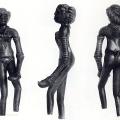
The dancing girl of Mohenjo-daro in three views, with close-ups of face, choker and bangles. John Marshall writes of this figure: "the arms and legs . . . are adorned with armlets, bangles, and anklets. These ornaments may sometimes have been made of metal, but in all probability the majority of them were shell. The custom of wearing so many shell bracelets as almost to conceal the whole of the forearm is very common in India at the present day." (Mohenjo-daro and the Indus Civilization, 1931, p. 339). >

Indus Elephants

It is unknown whether elephants were domesticated in the Indus Civilization. However, one of the few elephant figurines from Harappa is a head with large stylized ears and red and white stripes painted across the face. This may mirror the custom of decorating domesticated elephants (red and white are common colors) for ceremonies or rituals that is still practiced in South Asia. Elephant bones have also been found at Harappa. Approximate dimensions (W x H (L) x D): 5.4 x 4.8 x 4.6 cm. Photograph by Richard H. Meadow. See also Hollow Elephant Figurine from Harappa and Elephant Head. >

A Story Tablet from Harappa

One side of a planoconvex molded tablet found in 1995 in Mound ET at Harappa. Mark Kenoyer writes about his narrative scene depicting the killing of a water buffalo: "A person, possibly a man, with hair tied in a bun on the back of the head, impales a water buffalo with a barbed spear. The hunter's foot presses down on the water buffalo's head as he thrusts the spear into its shoulder. In Later Hindu rituals, the water buffalo sacrifice is associated with the worship of the goddess Durga, but on this seal the sacrifice takes place in the presence of a priest or deity seated in yogic position… >

Nikhil Gulati in Conversation about The People of the Indus

Omar Khan and Nikhil Gulati in conversation about The People of the Indus, the best-selling graphic novel about the ancient Indus civilisation shortly after its release. >

Pagination

  • Page 1
  • Page 2
  • Page 3
  • Page 4
  • Page 5
  • Page 6
  • Page 7
  • Page 8
  • Next page
  • Last page
Blog Posts by Subject (16)
  • Animals
  • Art
  • Children
  • City Life
  • Conferences
  • Crafts and Industry
  • Evolution
  • Excavations
  • Food
  • Homes
  • Media
  • Museums
  • Mysteries
  • News
  • People
  • Seals
© Harappa.com 1995-2026 31