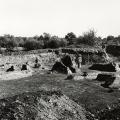
Harappa

Harappa, Punjab ancient Indus civilization excavations, figurines, seals and other objects.

"In January 1921, Rai Bahadur Daya Ram Sahni sank in the north-western part of this mound the diagonal Trench A, 16 ft. wide and 500 ft. long from south-east to north-west, starting from the centre of the mound and reaching almost to its north-weste… >

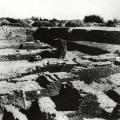
For Sahni’s description of the excavations at the area of the ‘parallel walls’ see ARASI 1924-25, pp. 76. The walls were both, stouter and thinner. Sahni mentioned that ‘the upper portion [of the former] is built solidly of burnt bricks,… >

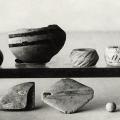
An assortment of personal ornaments, mostly beads, and a possible nose disc. Bottom row, 1st from left: Described by Vats as “cog-wheel shaped disc”, of which he found three found from Area H, from a burial jar (no. H149, published in Vats 1940, … >

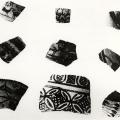
Nine sherds, painted potsherd Right, Top row: painting of a ‘Peacock and a hen facing each other’ Sahni documented this potsherd from Mound F, area of parallel walls with a copper nail extractor, several seals, a large copper chisel (Ae 342), te… >

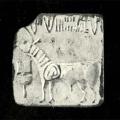
"Among the antiqui­ties found here was a seal die (No. A 214), Plate IX, Photos. Nos. 2817 a-b. It is square in shape, along each, side and provided with a round projection on the reverse pierced with a hole for the string by which it was suspended… >

It is appropriate that Daya Ram Sahni quickly found female figurines on Mound F at Harappa as he made the first incisions. Female figurines greatly outnumber those of men at ancient Indus sites. >

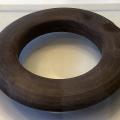
Dr. Kenoyer writes of this distinctive ancient Indus object (Ancient Cities, p. 145-46). "However, one style of bangle was always made the same size, between 5.5 and 6 cm interior diameter with a highly burnished surface fired to a red or a gray … >

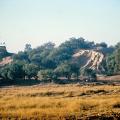
The high mound at Harappa (Mound AB) is surrounded by a massive mud brick city wall with large square ramparts. One of these eroding ramparts is visible through the underbrush that now covers the site. The flags mark the tomb of a Muslim saint that … >

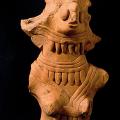
Female figurine with three sets of chokers and necklaces. This is one of the largest female figurines found at Harappa and it has the common fan shaped headdress with cups on either side of the head. Traces of black pigment or soot have been foun… >

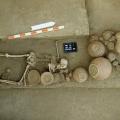
This burial was disturbed in antiquity, possibly by ancient Harappan grave robbers. Besides the fact that the body is flipped and the pottery disturbed, the left arm of the woman is broken and shell bangles that would normally be found on the left a… >