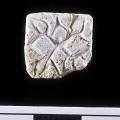
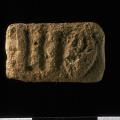
Button seal from the upper layers of Mound AB. Although this seal was found in mixed deposits dating to the Harappan and Late Harappan Periods, the carving suggests that it is actually an Early Harappan seal, dating to around 2800-2600 BCE. >
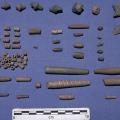
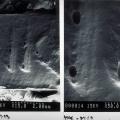
For the second group of tablets the leading edge of the incision is more rounded and there are grooves along the wide slope of the cutting angle. The third type of tool is equally distinct. When combined with tablets found in earlier years there are… >
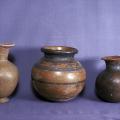
Three vessels of the Late Harappan Cemetery H period (after 1900 BCE). In the center is a small painted globular pot from a burial group. These forms and their surface treatments are quite distinct from the characteristics of the preceding Harappan … >
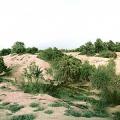
Panoramic view of Mound E with modern Harappa town at the far left. In the center are excavation areas from 1987-1990. At the right is the area of Trench 54, excavated in 2000, that exposes the earliest levels of the ancient Harappan Period city. >
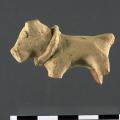
Terra cotta figurine of a dog with a projecting collar. This type of collar is today often used on fighting dogs to protect their throats (H2000-4968/2165-52, Mound E, Trench 54). >
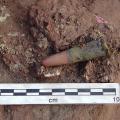
Part of a terra cotta kiln setter found in the Trench 54 South workshop debris. The tip is not vitrified and may have been buried in ash during the firing process. >
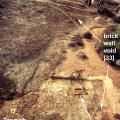
Overview of Trench 57 excavations that were continued in 2001 to reveal massive baked brick wall voids and additional baked brick drains. Looking West. >