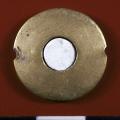
POSSIBLY WORN ON THE WRISTS OF PREHISTORIC INDIAN BEAUTIES SOME THREE THOUSAND YEARS AGO: BANGLES (ABOUT 3 1/2 IN. ACROSS) OF BLUE GLASS PASTE, FOUND AT HARAPPA >
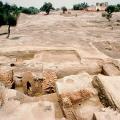
An overview of Mound E and ET looking north. Inside the city to the right of the corbelled drain and gateway is an area of the city that has been identified as a crafts quarter. Large quantities of manufacturing debris have been found in this area i… >
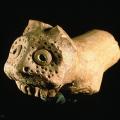
Tiger or leopard figurine with incised facial features, including punctated dots on the face that could be whisker marks. This figurine depicts a normal feline without horns or human face and therefore probably represents the actual wild animal. Han… >
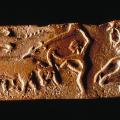
Plano convex molded tablet showing an individual spearing a water buffalo with one foot pressing the head down and one arm holding the tip of a horn. A gharial is depicted above the sacrifice scene and a figure seated in yogic position, wearing a ho… >
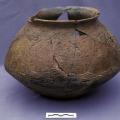
Cooking pots during the Ravi Phase were made in large globular shapes that had a low center of gravity to keep them from tipping over when filled with food. In order to protect the fine clay from cracking due to the heat of the fire, the exterior wa… >
Fired steatite beads appear to have been extremely important to the Indus people because they were incorporated into exquisite ornaments, such as this "eye bead" made of gold with steatite inlay found in 1995 at Harappa [Harappa Phase]. >
This map shows raw material distributions in the Indus Valley and adjacent regions. The extensive trade networks of the Harappan Period (2600-1900 BCE) linked distant resource areas to the major cities in the Indus and Ghaggar-Hakra river valleys. G… >
The so-called circular working platform area and workmen's quarters are seen in the mid-ground. New excavations of a circular working platform was begun in 1998 and continues in 1999. Initial results suggest that the platforms were not used for proc… >
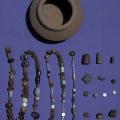
In the end, the small Late Harappan Period Pot yielded 133 beads and other decorative objects. Although left behind by a bead collector at almost 1700 BCE, the wide variety of beads and other objects found inside the pot belong to all periods of Har… >
In one of the rooms uncovered in Trench 54, a pottery fragment with a sunburst painted decoration was discovered that could be dated to the the beginning of the Harappan Period, perhaps as early as 2600 BC. >