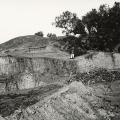
Trench B is the name given to a series of trenches dug in mound A-B over successive seasons by Dara Ram Sahni between 1921 and 1925. (See below for details in Vats' account) "The operations were then shifted to the mound marked A—B in General Cun… >
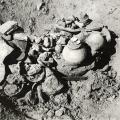
Published in ARASI 1924-25, Plate XXIV (d). Title: ‘Harappa: Mound F, Contents of a Cinerary Jar (A (F) 317)’ Sahni described the area this was found as: “between the trench “Ae” … and the long trench A, a large rectangular cutting A(f)… >
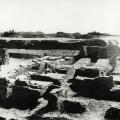
Another view of the excavations at the area of the Parallel Walls, which Sahni described as the most outstanding finds of the year. Sahni, as Vats subsequently mentioned, excavated the Eastern portion of this structure. For Sahni’s description o… >
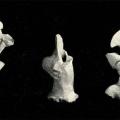
Find nos. AF12, P IV 100, B 1705. 1. Left: broken piece of a bangle, resembles Pl CXXXVIII, no 5, Possibly of faience. Vats noted: “Most of the faience examples are ornamented with cog-wheel edges or incised linear patterns” (Vats 1940, p. 448)… >
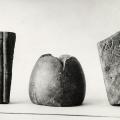
Left: Inscribed pottery Middle resembles no. 21, in Vats 1940 (Vol. II) Pl LXXXIII. Vats described this and another (no. 20) as quatrefoil cones. See Photo 54 for description of 20. “… No. 21 (PII-20) of red sandstone. This latter is the best… >
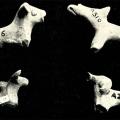
Daya Ram Sahni described these four objects as a "a terracotta dog (A 166), a ram (A 233) ; and two bulls (A 310 and C 14)" the latter of which he considered "nicely made" (p. 13, 26). The ram was found in the large earthen chati (A 233). He conside… >
Daya Ram Sahni quickly recognized the preponderance of female figurines; after describing the two male figurines found, he writes: "All the other human figures are female figures (Plate X, Photo. No, 2807-b) which appear to be crude cari… >
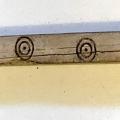
On this rod "with circles and lines, carved in ways that do not correspond to dice, may have been used for predicting the future (fig. 6.41)," writes Dr. Kenoyer (Ancient Cities, p. 120). Another ivory object in the gallery. >
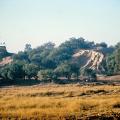
The high mound at Harappa (Mound AB) is surrounded by a massive mud brick city wall with large square ramparts. One of these eroding ramparts is visible through the underbrush that now covers the site. The flags mark the tomb of a Muslim saint that … >
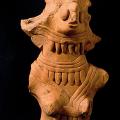
Female figurine with three sets of chokers and necklaces. This is one of the largest female figurines found at Harappa and it has the common fan shaped headdress with cups on either side of the head. Traces of black pigment or soot have been foun… >