Harappa

Harappa, Punjab ancient Indus civilization excavations, figurines, seals and other objects.

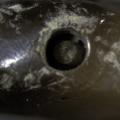
Tubular drill hole in an unfinished bead found from the bead pot (83) at Harappa. This unfinished bead with a tubular drilled hole suggests that bead workshops were still producing ornaments at Harappa during the Late Harappan Period, circa 1700 BC… >

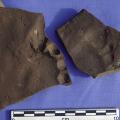
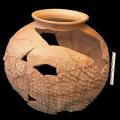
Flat, uneven, pottery discs used as baffles in the firing process were found in the pit with kiln debris from Trench 54 (slide 12). Two of these, broken during the firing of the kiln, bear the foot prints of small children. Pottery manufacture durin… >

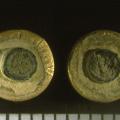
These two gold bead were originally part of the same ornament. Thin gold foil was placed over the outside of a sandy core around a copper tube (H2000-4382/2087-02, Mound E, Trench 54). >

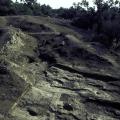
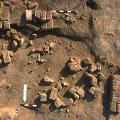
Overview of Trench 54 looking south to the slope on the far side where the steatite and faience workshop was discovered. >

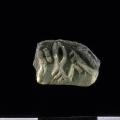
This uniquely shaped tablet (H2001-5090/2913-09), also made with two colors of faience, has an inscription similar to that seen on the previous slide (67). This tablet was found inside the workshop in Trench 54 South. >

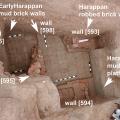
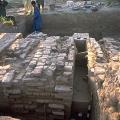
Overview of the excavations showing the Harappan (Period 3) and Early Harappan (Period 2) walls on the west side of Trench 54. North is to the right. >

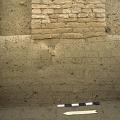
Section through the northwestern portion of the "granary" platform directly below the baked brick "granary" walls (Trench 1NW). Similarity of composition of the mud-bricks in the northwestern, southwestern, and southeastern parts of the "granary" pl… >

After clearing an interior area in the southeast part of the "granary", it became evident that the inner baked brick wall of the original structure had been dismantled by the ancient Harappans before they filled in the resulting void and built the o… >