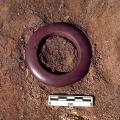
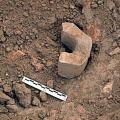
Red stoneware bangle (H2000-4490/9843-01) with no inscription. The lack of inscription may indicate that this may have been a place where the bangles were stored prior to inscribing them for distribution. >
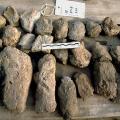
Ravi phase hand-formed (not in molds) mud-bricks were found in the early levels mixed with ash and broken pieces of pottery. They may originally have been part of a firing structure or kiln. >
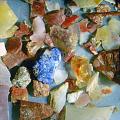
Flakes of various shades of agate, carnelian, jasper, chert, and lapis lazuli indicate the range of raw materials being processed in this part of Harappa during the Ravi phase. All of these raw materials were brought to the site from distant res… >
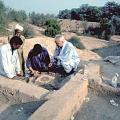
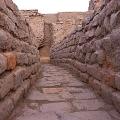
This view along Drain [8] into the mound shows details of the brick construction, the robbed out area at the east end of the drain (background), sloping strata above indicating the existence of an open street drain along the same line as the ear… >
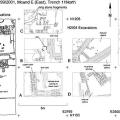
Excavations during the 1997-2001 seasons were carried out inside perimeter wall [250]. Here a partial plan of those excavations shows superimposed levels of Period 3C buildings, all mostly robbed of their baked brick walls. [Mud-bricks are hatched, … >
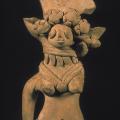
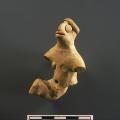
Some of the female figurines are very ornate with elaborate headdresses, chokers and/or necklaces, and decorated multiple-strand belts. The fan-shaped headdresses sometimes have panniers or cup-like attachments on either side of the head and depicti… >
A few male figurines demonstrate unusual postures such as one with one leg extended forward and the other extended behind. Male figurines also sometimes wear a simple headband around the top of the head. Approximate dimensions (W x H x D): 4.3 x… >
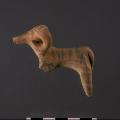
The ram figurines are also sometimes decorated with black stripes and patterns. Some may be painted black. Occasionally, incised "wool" is depicted on the bodies of sheep figurines. Approximate dimensions (W x H(L) x D): 3.3 x 6.6 x 6.3 cm. >