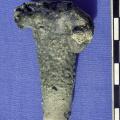
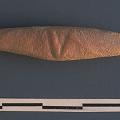
A glazed terra cotta kiln setter with bone fused onto the splayed surface appears to have been an important part of the firing process in the Trench 54 South faience workshop. >
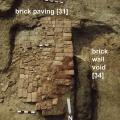
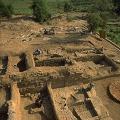
In Trench 57 West, excavations in 2001 revealed a large paving of backed bricks that may have been part of a courtyard or room originally bordered by massive baked brick walls. >
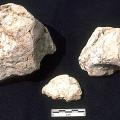
Large lumps of a bluish grey paste that may have been used to make faience objects. Faience is made by melting quartz rock and then regrinding the glassy frit to make a paste that is then fired once again. Indus faience is sometimes multicolored (se… >
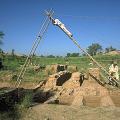
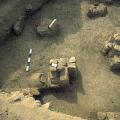
Overview of Trench 43 in 2000 looking north, showing the HARP-exposed circular platform in the foreground and the "granary" area in the background. Note the wall voids to the west, south, and east of the circular platform (see also image 86) >
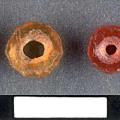
Many broken and unfinished stone beads of carnelian (red-orange) and amazonite (blue-green) were found in the floor levels associated with the Ravi phase pits and hearths. (See also slide 119.) >
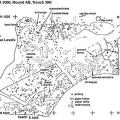
This plan shows concentrations of bead manufacturing debris on several superimposed Ravi phase floor levels that indicate the positions of actual work areas. >
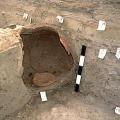
At the bottom of the Kot Diji phase storage vessel was a broken lid and charcoal that was used for dating the fill inside the pot. There is a 91 percent chance that the date obtained from this charcoal falls between 2602 and 2445 radiocarbon years B… >