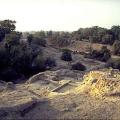
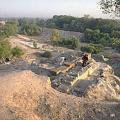
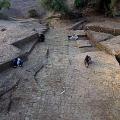
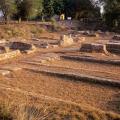
North end of Harappa Mound AB, looking down on the Kot Diji phase levels from the heights above the Harappa phase baked brick wall (on the right) that has been covered with protective plaster for conservation. In the background (to the North) is… >
The reconstructed brick wall is covered each year with a protective coating of clay and straw plaster. The original structure and unexcavated levels remain safely buried beneath a layer of bricks and back dirt. >
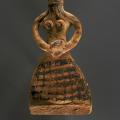
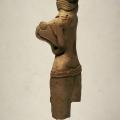
Another style of Early Harappan female figurine holds a round object, possibly a vessel, with both hands at the waist above a flaring lower body which ends in a (broken) forward-extending base. The hair is bound at the back of the head into a tiered… >
The female figurine usually holds the infant's head to her breast with one or both arms encircling the infant. Approximate dimensions (W x H x D): 3.2 x 8.4 x 1.9 cm. >
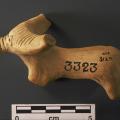
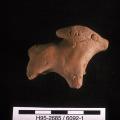
Water buffalo are often similar to figurines of humpless cattle, except that the water buffalo figurines usually have large (and sometimes incised) backswept horns. Approximate dimensions (W x H(L) x D): 6.0 x 8.0 x 6.0 cm. >
Some animal figurines with long ears, especially those with the ears laid back against round hollow bodies, have been identified as hares. One animal figurine with long ears laid back above a small solid body may also represent a hare. Figurines wit… >
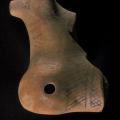
A small subset of the figurines from Harappa originally had wheels. Of the many small terracotta wheels found at Harappa, at least some must have been intended for these wheeled objects. One style of wheeled figurine has lateral holes for the axles … >
No grain, storage containers or clay sealings such as would have been attached to goods for shipment were found in the so-called "Granaries" of Harappa or Mohenjo-daro. Archaeologists today prefer to call these structures great halls, since they wer… >
No "Great Bath" like that in Mohenjo-daro has been found in Harappa, and it is not known if one existed among the miles of ruins carted off for railway construction in the early 1850's. A large bath does however exist very near the mounds, construc… >