Harappa

Harappa, Punjab ancient Indus civilization excavations, figurines, seals and other objects.

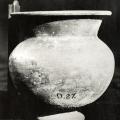
There are several photographs of the earthen jar D27 that was found on Mound A-B. This was one of the earliest complete pots discovered at Harappa. That this pot was one of the images published by Marshall in his announcement in the Illustrated Lond… >

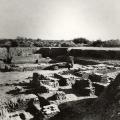
View of the parallel wall area, Mound F, noted subsequently by Vats as the eastern part of the Great Granary. For Sahni’s and Vats’s description of the excavations of this area see Parallel Walls. See Plate III Vats 1940 Vol II for a ‘Plan of … >

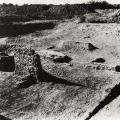
View of the area, of the pits in AB, before deep digging. Traces of structures of bricks and possibly of the gabled drain. >

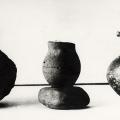
Three jars, the one in middle on a stand, has a band of two incised lines in the middle. Left: the surface has impressed marks on clay. Flat bottom. >

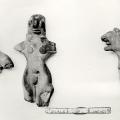
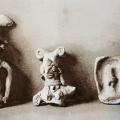
Two terracotta male figurines, nude. Left: Male figurine, nude, published in Vats 1940 (Vo. II), no. 21. Find no. A. 19, 1.7 in high “found at a depth of 2 ft. 6 in. b.s., in Mound F, Great Granary Area, Stratum I” (Vats 1940, p. 296) Vats… >

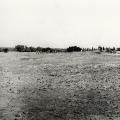
"The mound was covered with potsherds and brick bats, but no brick foundations were visible anywhere that might have served as a starting point." - Daya Ram Sahni, Annual Progress Report of the Archaeological Survey [of India], Hindu and Budd… >

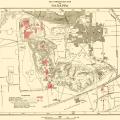
This map of Harappa was published by Madho Sarup Vats in his 1941 monograph on Harappa Excavations at Harappa: Being an account of archaeological excavations at Harappa carried out between the years 1920-21 and 1933-34. Volume I - Text; Volume I… >

[This and the next full page in the Sept. 20, 1924 issue were printed in sepia, preserved here in the images. This complete text across both full pages is given below.] WITH HEADDRESSES RECALLING THE MEDIAVAL FASHIONS IN EUROPE: FIGURINE… >

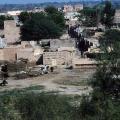
A view of modern Harappa city which is built on top of a large portion of the ancient mound. Many of the streets and houses of the modern town are built directly above earlier streets and houses of ancient Harappa. >

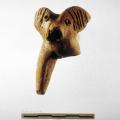
Terra cotta ram figurine from Harappa. Such figurines may represent sacrificial animals used in specific annual rituals. Harappa Archaeological Research Project. >