
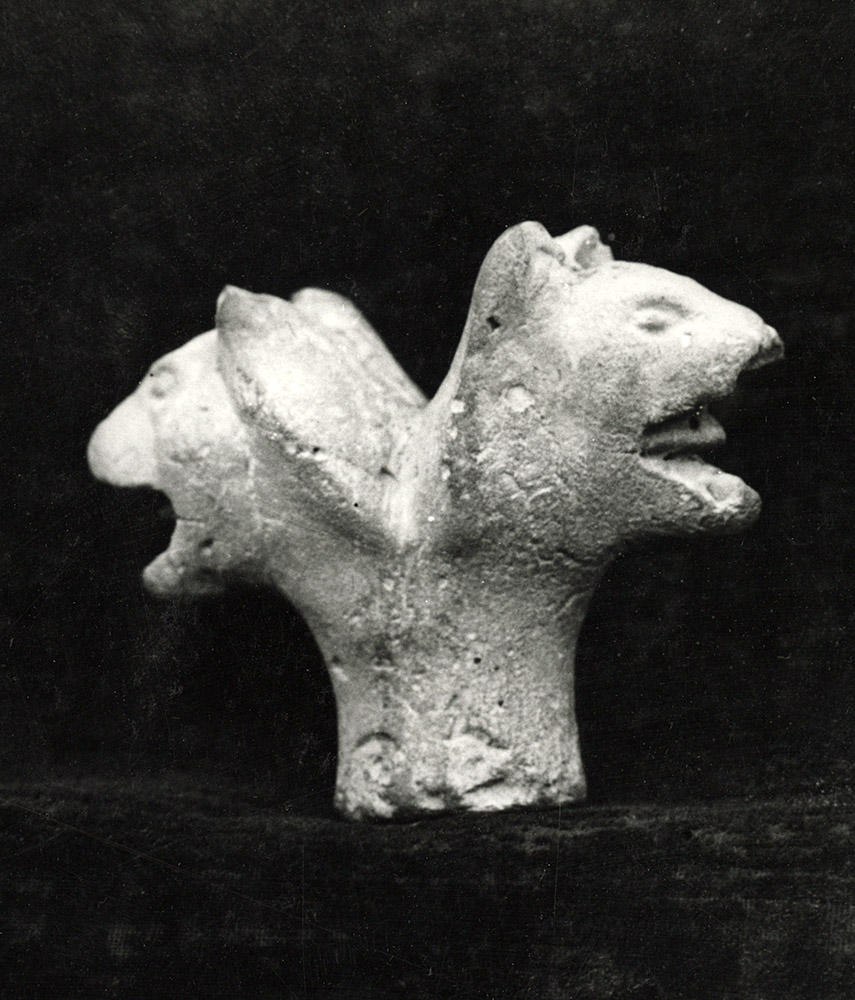
Published in ARASI 1924-25, Plate XXVII (f), with the ‘cone’ base. Title: ‘Double-headed Terracotta bust of a Lion’
Published in Vats 1940, Vol. II, Plate LXXIX, 88. Described as ‘A Jugate Tiger Head’
The field number of this object is A. 813, and the noted height 2”. From Mound F, Trench A in the area of the parallel walls.
Sahni: “The portion between walls numbers 4 and 17 is paved with brick laid on-edge, but whether the rest of it is similarly paved is more than can at present be said. The portable objects found in this area were numerous. They include a double-headed terracotta bust of a lion (A.813---height 2”, Plate XXVII, f) which must have been mounted on a cone of the same material (as shown in the photograph) and presented as an offering at a temple”, and “Not far from this was found a deposit of oval-shaped tablets of alabaster with cracked surfaces”.
- Daya Ram Sahni, ARASI 1924-25, p. 76-7.
Vats: “Westward along the north-western end of Trench A Mr. Sahni made another extension. It is 90 ft. long from east to west and averages 55 ft. in width. It was excavated to a depth of 4 ft. 6 in. only and revealed several fragmentary walls and broken pavements of the IInd stratum between 2 ft. to 3 ft. 3 in. below the surface, and a few walls of the Illrd stratum at a depth of 4 ft. 6 in.”
“Parallel to and at a distance of about 20 ft. from the northern edge of this extension is a fairly thick, though fragmentary, wall of the Illrd stratum which extends for about 80 ft. from east to west. Only two broken party-walls on the south, of which one is thicker than the other, appear to be connected with it. Between this wall and the southern edge of this extension were found a faience sealing (No. A816, PI. XCV, 397) inscribed with a svastika, a unicorn seal (No. A336, PI. LXXXVIII, 105), three stone beads including one of banded agate (A307), a small chert weight [footnote 1: size .5x.43x.38 in] (A67), fifteen oval tablets [footnote 2: These might have been used as palettes] of alabaster (A525) ranging in size from 2.25 by 1.9 to 4.2 by 3.1 in. (PI. CXVII, 52 and 55), and a well executed, jugate terracotta tiger-head (A815) springing from a holed base (PI. LXXIX, 88). Each of the tigers has two holes on its head, possibly for fixing horns. [footnote 3: On the Mohenjodaro seal No. 357 a horned tiger is being attacked by a composite monster, cf. Sir John Marshall op.cit. p.76, Pl. XIII, 17] The conception of this chimera creature is paralleled in the representation of the triple, interlaced tigers on seal 386 [footnote 4: Ibid, p. 67, Pl. XIII, 17] from Mohenjo-daro. Close to the alabaster tablets mentioned above was found a well preserved copper blade-axe (A784) with tapering sides. It is 3.75 in. long, 2 in. wide and is inscribed with the figure of a bat on one side.” (Vats p. 24-5)
“No. 88 (A815) is a bi-jugate chimaera-head springing from a common neck. Each head has two holes on the top probably for fixing horns [footnote 2: These holes could also have been inlaid purely for ornamentation]. Representations of bi-jugate and multi-jugate animal beads or figures are also found on seals illustrated in M. I. C., PI. CXII, 382, 383, 386 and 387. Possibly it was a cult object of worship, the duplication of heads being intended to increase at once the prowess and sacred character of the beast. Ht. 1-95 in. Mound F, North-West Extension of the Great Granary Area, Square H 8/7; Depth 2 ft. 6 in. b.s., Stratum III.” (Vats, p. 308)
- Vats, M.S. 1940, Vol. I, pp. 24-5; 308.
Note the two different field numbers of the object. Sahni's is A 813. Vats's is A 815.
Note also the different description of the object, and the reasons for noting this as a horned tiger, a ‘chimera creature’.