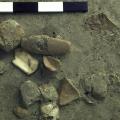
A terra cotta pestle that may have been used for sanding wooden planks was found discarded along with broken pottery in an early Harappan Period 3B deposit in Trench 54. >
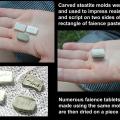
Stages in the manufacture of faience tablets. First it is necessary to make the faience paste and the steatite molds. Then the paste is formed into a rectangle and impressed on both sides by the molds. Finally the molded tablets must be dried slowly… >
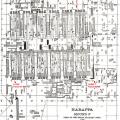
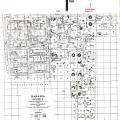
Plan view of the so-called "granary" or "parallel-wall structure" on Mound F at Harappa indicating areas of HARP excavations conducted in 1997 and 1999. Note that the structural remains surrounding the "granary" are, for the most part, later than th… >
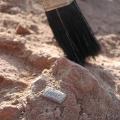
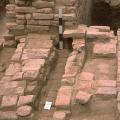
Detail view of a hollow area that would originally have held a wooden beam bonded into the baked brick structure. In the background is a wall remnant from the later rebuilding of the "granary". >
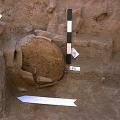
Excavation of the fill inside the jar (image 33) indicates it was left exposed for some time and gradually filled with silt as the room became covered with debris (Trench 41NE). >
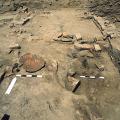
A broken terracotta bird cage (near the scale at right) was discovered next to the remains of a broken storage jar that had been reused as a hearth (near the scale at left) (Trench 43). >
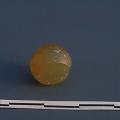
Spherical agate weight with one side flattened (H2000-4496/9880-01). This weight does not conform to the standard Harappan weight system and may indicate the use of a separate weight system for international trade with Central Asia or other regions. >
Plan of Vat's excavations showing circular platforms. In some cases remnants of the baked brick walls that probably surrounded each platform can be seen on the plan, although earlier and later walls are also shown. From M.S. Vats (1940) Excavations … >
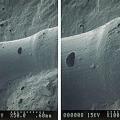
Scanning electron microscope photos of a molded impression of the drill hole indicate that the amazonite bead (8) was drilled with a tapered chert or jasper drill. >