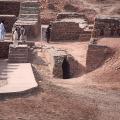
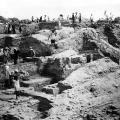
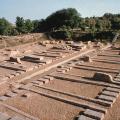
Ancient Indus Civilization "granary" excavations and materials. Note that the earlier interpretation of these constructions are Harappa and Mohenjo-daro in particular are not thought of as granaries by modern archaeologists; their purpose remains unclear.
This drain cuts through the edge of the so-called granary. If the entire drain were constructed along with the Great Bath, this feature would indicate that the original "granary" was built before the great bath. >
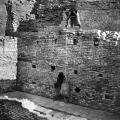
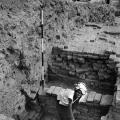
REM Granary Wheeler had workmen lifting bags of grain with ropes to illustrate his interpretation of the loading dock at the north edge of the so-called "granary". The square voids in the wall face would have been where wooden beams were inserte… >
Deep digging at the southeast corner of the "granary" revealed an earlier building [wall 330] constructed along the same east-west alignment. This structure could have been built as early as the beginning of Period 3B, ca. 2450 BC. The currently vis… >
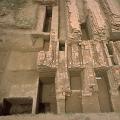
Built on top of a tapered brick platform, this building had a solid brick foundation that extended for 50 meters east west and 27 meters north south. The foundation was divided into 27 square and rectangular blocks by narrow passageways, two running… >
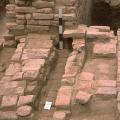
REM Granary Looking to the northwest along the edge of the slope where small rooms and a massive platform made of fired brick was exposed. This platform was interpreted as part of a loading dock area for the so-called "granary". The small walls a… >
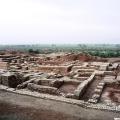
A general view of the "Great Bath" and adjoining rooms. In the background is a massive brick structure referred to as the "Granary". Built on top of a tapered brick platform this building had a solid brick foundation that extended for 50 meters east… >
Detail view of a hollow area that would originally have held a wooden beam bonded into the baked brick structure. In the background is a wall remnant from the later rebuilding of the "granary". >
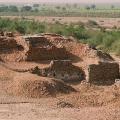
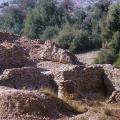
The eroding wells and a wall built up against the granary show that much of the area to the north of the granary was filled with debris and later buildings. >
REM Granary Overview of the REM Granary excavations, viewed from the northwest. The fired brick mass of the western slope is visible at the right. No. 91 Also "1101" penciled on back >
The so-called "granary" of Harappa is found on Mound F. It is a brick structure that was built on a massive brick foundation over 45 meters north south and 45 meters east-west. Two rows of six rooms that appear to be foundations are arranged along a… >