Home

Main navigation

  • home
  • slides
  • essays
  • articles
  • books
  • video
  • q & a
  • blog
Secondary menu
  • about us
    • scholars
    • privacy
    • support
    • image rights
    • credits
    • contact us
  • resources

Ancient Indus Civilization "granary" excavations and materials. Note that the earlier interpretation of these constructions are Harappa and Mohenjo-daro in particular are not thought of as granaries by modern archaeologists; their purpose remains unclear.

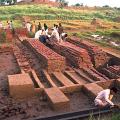
Baked brick revetment of the "granary" platform

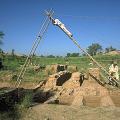
J. Mark Kenoyer sitting in the right foreground takes notes during excavations at the southwest corner of the "granary" (Trench 1SW). The baked brick revetment of the "granary" platform is in the foreground, the southernmost baked brick wall of the … >

J. Mark Kenoyer videoed the "granary"

In addition to documentation with still photography, J. Mark Kenoyer videoed the "granary" areas excavated and narrated details of the stratigraphy and of the brick construction. >

Modern Harappa Granary

A good counter example to "Great Granary" having been used to store grain is this actual granary popular in the villages surrounding Harappa. Grain is stored in earthen structures, and accessed as needed through a re-sealable hole at the bottom. >

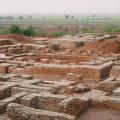
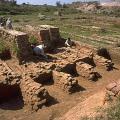
Harappa Granary Area

Another view at sunset of the granary rooms and sleeper walls. >

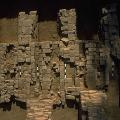
A massive baked brick revetment wall

A massive baked brick revetment wall [329] surrounds the solid mud-brick foundation platform [50] of the "granary" that measures approximately 51 meters north-south and 41 meters east-west. Based on analysis of the pottery and other finds from below… >

Empty channel between two "granary" walls.

This image looking east shows baked brick rubble and trash that had spilled through the corbelled arch of a buttress from the exterior street into a then empty channel between two "granary" walls. >

Guard hut, Harappa

Contemporary guard hut overlooking the "Granary." Many questions about ancient Harappa will never be answered. But with the first modern, multi-disciplinary excavations of an Indus city at Harappa, many misconceptions are being laid to rest and much… >

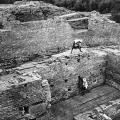
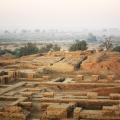
Mohenjo-daro Upper Part of Podium of Great Granary

"Mohenjo-daro Upper Part of Podium of Great Granary as seen from the loading platform showing late walls (on earthen supports built when the ground-level had risen to the top of the podium (excavated 1950) (p. 127)." Wheeler caption >

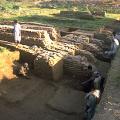
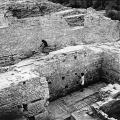
The northwest corner of the "granary" platform

Excavations in 1997 at the northwest corner of the "granary" platform were undertaken to follow the outline of the structure and document its construction (Trench 1NW)). >

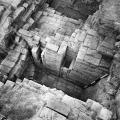
An interior area in the southeast part of the "granary"

After clearing an interior area in the southeast part of the "granary", it became evident that the inner baked brick wall of the original structure had been dismantled by the ancient Harappans before they filled in the resulting void and built the o… >

Pagination

  • Page 1
  • Page 2
  • Page 3
  • Page 4
  • Page 5
  • Page 6
  • Next page
  • Last page
© Harappa.com 1995-2026 31