Home

Main navigation

  • home
  • slides
  • essays
  • articles
  • books
  • video
  • q & a
  • blog
Secondary menu
  • about us
    • scholars
    • privacy
    • support
    • image rights
    • credits
    • contact us
  • resources

Harappa

Harappa, Punjab ancient Indus civilization excavations, figurines, seals and other objects.

General view of Harappa Mound F from S.W. before excavation

"Mound F is the northernmost mound on the site, and measures roughly 780' from north to south by 970', from east to west. At the time of General Cunningham’s visit the height of this mound was 2.5 to 30 feet above the surrounding land, and it is still about the same." >

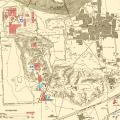
Harappa Comparative Chronology (1940)

  • Letter Map

"The number of strata varies considerably in different mounds which are not all contemporary with each other. In the present state of our knowledge their dating can hardly be definite. At best it must be rough and provisional, with a fair margin for error when accounting for the upper and lower limits of the culture1 at Harappa as revealed up till now. On the basis of the evidence regarding the chronology of Mohenjo-daro, which has been so ably discussed Comparative by Sir John Marshall,2 I tabulate below the tentative and comparative age of Mounds F, AB, Areas J and G, and of the Cemetery H. >

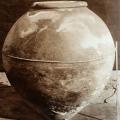
Earthern Stone Jar from Harappa

TAPERING AT THE BASE: A PREHISTORIC EARTHERN STORE JAR FROM HARAPPA (WITH A TWO-FOOT RULE BESIDE IT). >

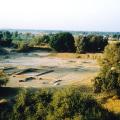
Mound F, Harappa

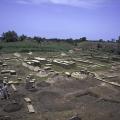
An overview of the area on Mound F as seen from the city wall on Mound AB. The circular working platforms are in the background and a row of identical houses that were clearly made all at one time, possibly a housing project of some wealthy merchant… >

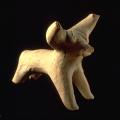
Bull figurine

Terra cotta figurine of a bull from Harappa without a hump. There may have been many species of bulls used in different parts of the Indus valley. >

Steatite beads

These tiny steatite beads were found in the Harappan cemetery and come from an elaborate hair ornament worn by a male individual. Each bead is less than .01 cm long and less than .01 cm diameter. A human hair is shown to give an idea of the minute s… >

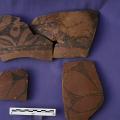
Ravi Phase Motifs

Whereas many other motifs of the Ravi Phase (Period 1) disappear in the later Kot Diji Phase (Period 2), the intersecting circle and fish scale motifs continued to be used, but they came to be executed in black paint on a red slip. In this image the… >

Steatite beads

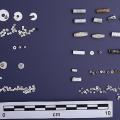
Steatite beads from the Early Harappan Periods at Harappa. On the right are many different styles of Ravi Phase beads (circa 3300-2800 BC). Note the blue green glazed bead in the center and the row of unfired beads in the second to the bottom row. T… >

Sealing find

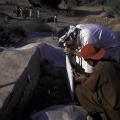
One of the most exciting discoveries of the 1998 excavation season was finding a seal impression or sealing in a hearth of the Early Harappan Period (Kot Diji Phase, circa 2800 BCE). Here William Belcher is seen photographing the important discovery… >

"Granary area"

Limited excavations in the granary area at Harappa starting in 1997 (Trench 41 area) and 1999 have begun a new examination of this important building, first excavated in the 1920s. Although referred to as a granary, this characterization by earlier … >

Pagination

  • First page
  • Previous page
  • …
  • Page 39
  • Page 40
  • Page 41
  • Page 42
  • Page 43
  • Page 44
  • Page 45
  • Page 46
  • Page 47
  • …
  • Next page
  • Last page
© Harappa.com 1995-2026 31