Home

Main navigation

  • home
  • slides
  • essays
  • articles
  • books
  • video
  • q & a
  • blog
Secondary menu
  • about us
    • scholars
    • privacy
    • support
    • image rights
    • credits
    • contact us
  • resources

Jonathan Mark Kenoyer

Slides on the archaeology and excavation of ancient Indus Valley sites including Harappa by Jonathan Mark Kenoyer of the University of Wisconsin, Madison.

Seals and sealing

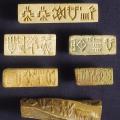
Long rectangular seals and a terra cotta sealing (bottom) with Indus script. The top seal has seven signs of Indus script. The back of this seal is convex and it is perforated from the side. The central sign may represent a house or temple and is a … >

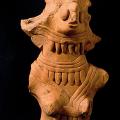
Female Figurine

Female figurine with three sets of chokers and necklaces. This is one of the largest female figurines found at Harappa and it has the common fan shaped headdress with cups on either side of the head. Traces of black pigment or soot have been foun… >

Terra cotta discs

One of the games played by the children of the Indus cities may be represented by terra cotta discs found in graduated sizes. A game called "pittu" is played throughout Pakistan and northern India even today, with stacks of pottery discs and a ball … >

Faience ornaments

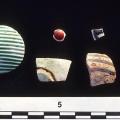
A collection of faience ornaments from Harappa. The Harappans developed a very compact glassy faience that was produced in a variety of colors, ranging from white, to blue green, deep blue and even red-brown. On the left is a disc shaped ornament of… >

Farmlands to the west of Mohenjo-daro

  • Farmlands to the west of Mohenjo-daro

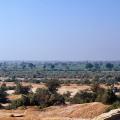
West of the "citadel" mound are lush farmlands watered by modern irrigation channels. A levee protecting the site from annual floods divides the irrigated land from the salt encrusted sediments surrounding the ancient site. The high salinity of the … >

Great Bath and Granary, SD Area, looking west from the stupa mound

  • Mohenjo-daro, Great Bath and Granary, SD Area, looking west from the stupa mound

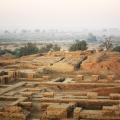
The great bath surrounded by a brick colonnade, measures approximately 12 meters north-south and 7 meters wide, with a maximum depth of 2.4 meters. In the background is a massive brick structure with narrow passages that was first identified as a ha… >

Granary, SD and REM area

  • Mohenjo-daro Granary, SD and REM area

Built on top of a tapered brick platform, this building had a solid brick foundation that extended for 50 meters east west and 27 meters north south. The foundation was divided into 27 square and rectangular blocks by narrow passageways, two running… >

Wells and walls, DK-G Area

  • Mohenjo-daro, Wells and walls, DK-G Area

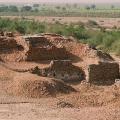
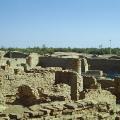
This general view of DK-G area shows multiple walls built at different time and two wells that were used up until the last phase of occupation. >

Limestone drain covers, SD Area

  • Mohenjo-daro, Limestone drain covers, SD Area

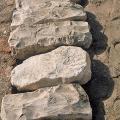
This large drain was partly covered along its length with large flat blocks made out of limestone from the Rohri hills, which are located to the north and on the other side of the Indus River. >

Covered Drains Leading from the Dyer's Workshop, VS Area

  • Mohenjo-daro, Covered Drains Leading from the Dyer's Workshop, VS Area

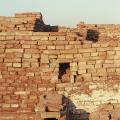
A small drain leads from the well and finely fitted brick floor of the dyer's workshop to a covered drain at the edge of the street. >

Pagination

  • First page
  • Previous page
  • …
  • Page 5
  • Page 6
  • Page 7
  • Page 8
  • Page 9
  • Page 10
  • Page 11
  • Page 12
  • Page 13
  • …
  • Next page
  • Last page
© Harappa.com 1995-2026 31