Slides on the archaeology and excavation of ancient Indus Valley sites including Harappa by Jonathan Mark Kenoyer of the University of Wisconsin, Madison.
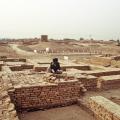
The side walls of the tank were constructed with finely fitted bricks and a thick layer of bitumen (natural tar) was laid along the sides of the tank to keep water from seeping through the walls and up into the superstructure. >
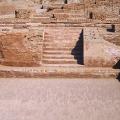
Many houses had stairs leading to upper courtyards of the building or to a second floor. This house in HR area had a double staircase that would allow people to enter and exit the upper courtyard in an orderly fashion. Some scholars feel this may ha… >
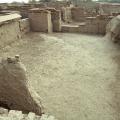
This large room or courtyard was filled with a solid mud brick platform that was almost entirely excavated to investigate the underlying room. A section of the platform has been preserved beneath the tin roof on the left and part of the platform is … >
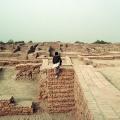
The UM excavations conducted by Dr. G. F. Dales in 1964-65 exposed a massive mud brick platform that was used to raise a group of brick buildings several meters above the street level which was seen in the foreground. The street was approximately se… >
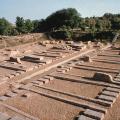
The so-called "granary" of Harappa is found on Mound F. It is a brick structure that was built on a massive brick foundation over 45 meters north south and 45 meters east-west. Two rows of six rooms that appear to be foundations are arranged along a… >
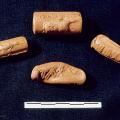
Terra cotta tokens or tablets from Harappa. In Area G, south of the recently discovered gateway on Mound ET(20), excavators found a concentration of as many as 31 identical cylindrical terracotta tablets (top center), but it is not known what they c… >
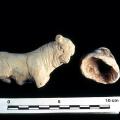
Humped bull figurine with molded head that is twisted to the side, and a mold used to make the head. The legs were made separated rather than being joined together. Hand formed body and attached head. Eyes are carved with appliqué pupils as on the l… >
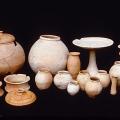
Collection of burial pottery without any painted designs. These vessels come from one of the later burials towards the end of the Harappan period, possibly dating to 1900 B. C. >