Slides on the archaeology and excavation of ancient Indus Valley sites including Harappa by Jonathan Mark Kenoyer of the University of Wisconsin, Madison.
The eroding wells and a wall built up against the granary show that much of the area to the north of the granary was filled with debris and later buildings. >
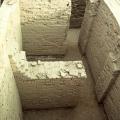
This view into two small rooms shows tapered walls that were built to support a second floor. Later rooms were built directly on top of these walls because they provided a strong foundation. The wall of the building across the street shows multiple … >
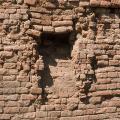
Many of the buildings at Mohenjo-daro had two or more stories. Water from the roof and upper storey bathrooms was carried through enclosed terracotta pipes or open chutes that emptied out onto the street, such as this one on a house in DK-G Area. (S… >
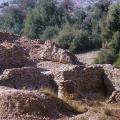
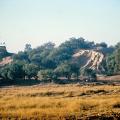
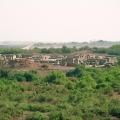
The high mound at Harappa (Mound AB) is surrounded by a massive mud brick city wall with large square ramparts. One of these eroding ramparts is visible through the underbrush that now covers the site. The flags mark the tomb of a Muslim saint that … >
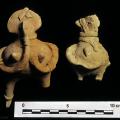
Fat women figurines with turban-like headdress and appliqué ornaments. Bangles are worn on both wrists and upper arms, ankle bracelets and a choker probably represent beaded ornaments. The right hand is held to the mouth and the left hand clutches t… >
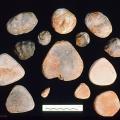
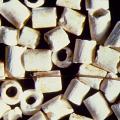
Terra cotta nodules and cakes of different shapes are common at most Indus sites. These objects appear to have been used in many different ways depending on their shape and size. The flat triangular and circular shaped cakes may have been heated … >
These tiny steatite beads were found in the Harappan cemetery and come from an elaborate hair ornament worn by a male individual. Each bead is less than .01 cm long and less than .01 cm diameter. A human hair is shown to give an idea of the minute s… >
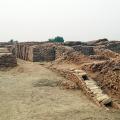
The northeastern sector of Mohenjo-daro was excavated by K. N. Dikshit and designated DK-G area. Pathways allow visitors to visit the excavations, and an unexcavated portion of the site in the right foreground show what the site looked like prior to… >