Slides on the archaeology and excavation of ancient Indus Valley sites including Harappa by Jonathan Mark Kenoyer of the University of Wisconsin, Madison.
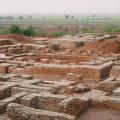
The Great Bath is situated along a north-south street with a drain covered with limestone blocks. In the background is the so-called Granary, while in the foreground are the walls of several domestic structures. >
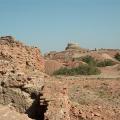
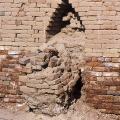
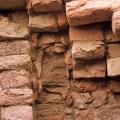
A massive block of brick architecture at the southeast corner of the "citadel" mound was thought to represent a gateway with large brick bastions. Later construction of a wall (in the center of the photo) blocked the entryway. >
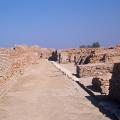
Looking north along the street to the east of the Great Bath. The building on the right is a single large structure called the College, and may have been the residence of priests or other elites (see Slide 38). >
Many drains from upper buildings were directed to the street through enclosed channels or terracotta pipes. The pipes were made using multiple telescoping segments that fit snugly with the next segment. >
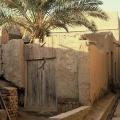
The old part of the city of Sehwan, Sindh, is built on a high mound of the earlier buried city, much like ancient Mohenjo-daro. A neighborhood well is located alongside the street that has an open drain. A private courtyard is shaded by a date palm… >
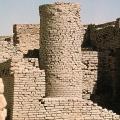
Private wells were rebuilt over many generations to serve the needs of a large household or neighborhood. This well in DK G area at Mohenjo-daro stands like a chimney because all of the surrounding earth has been removed by excavation. >
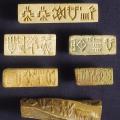
Long rectangular seals and a terra cotta sealing (bottom) with Indus script. The top seal has seven signs of Indus script. The back of this seal is convex and it is perforated from the side. The central sign may represent a house or temple and is a … >
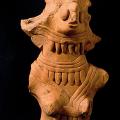
Female figurine with three sets of chokers and necklaces. This is one of the largest female figurines found at Harappa and it has the common fan shaped headdress with cups on either side of the head. Traces of black pigment or soot have been foun… >
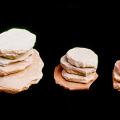
One of the games played by the children of the Indus cities may be represented by terra cotta discs found in graduated sizes. A game called "pittu" is played throughout Pakistan and northern India even today, with stacks of pottery discs and a ball … >