Evolution or Revolution? Has recent research (that of the last 20 years ) given any new insights? Submitted by Gharial Abramnova from school student questions
What is known about the food habits of the Indus Valley people? Have any cooking utensils/equipment, charred remains of food or agricultural implements been found? Wheat kind of bread was their staple, perhaps baked in ovens or cooked over fire? Did they grow lentils - one of the key elements of sub-continental food? Submitted by Colleen
Or were there any mediators in Iran (which had a civilization in ancient periods which was located in the southwestern part of fertile cresent region)? As you know, the Rosetta Stone was issued by Ptolemy \/ - which was due to interactions between the Greeks and Egyptians. This interaction started with settling of Ionians and Cretans as per by Herodotus. Could it be that these mediators would have used both the cuneiform and Indus valley script? What are the possibilities of finding a bilingual according to you? Submitted by Arthur Evans
The people of the Indus valley seem to have exported many more goods than they seem to have imported. Moreover, imported items like silver (found mainly in Harappa and Mohenjodaro) did not seem to have been distributed beyond the main cities suggesting that there was little demand for the goods in the smaller centres. Does this suggest that, if, as has been suggested, the Indus people took the initiative for the trade, this was a centralised effort that profited only the cities? Submitted by Apoorva Bhandari
Or ever two distinct artifacts with the same sets of fingerprints on them? Is there anyone studying indus valley artifacts with this approach and is there anything we can tell from it? Submitted by Ezb
Jane McIntosh
I am not aware of any studies specifically dealing with fingerprints on Harappan pottery. Kenoyer notes that some of the Ravi-period (pre-Harappan) beads at Harappa were decorated with finger marks.
Why (as far as I know) was all the chert obtained from the Rohri Hills and distributed everywhere else? What does this tell us about the nature of the Harappan economy and society? Submitted by Gharial Abramnova from school student questions
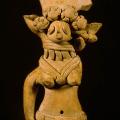
A stark contrast between the features of human figurines and masks of IVC period strikes me. Men have a narrow sloping forehead like a Neanderthal, whereas women exhibit a prominent vertical forehead with a much higher hairline. If my observation stands scrutiny, one possibility that comes to mind is that: Feminine beauty was exemplified by women of a race other than the one inhabiting the IVC. Somewhat like all Barbie dolls possess long limbs irrespective of which race they are supposed to represent. Does that hypothesis make sense? Submitted by Vasant Dave