Home

Main navigation

  • home
  • slides
  • essays
  • articles
  • books
  • video
  • q & a
  • blog
Secondary menu
  • about us
    • scholars
    • privacy
    • support
    • image rights
    • credits
    • contact us
  • resources

People

Posts relating to people, gender, artistic representations, and common types in the ancient Indus Valley Civilization.

Headdresses or Hair?

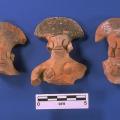
Three female figurines with painted fan-shaped headdresses from Harappa. Could these headdresses have represented black hair stretched over a frame of bamboo or other material? See also Gender and the Indus People: An Unusual Male Figurine and Harappan Female Figurine. >

Harappan Burial Pottery

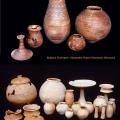
Painted and unpainted burial pottery from Harappa. The two largest vessels were found in the same burial and are described below. The other smaller vessels were found in an earlier burial and represent an older style of pottery. The bottom images shows a collection of burial pottery which come from one of the later burials towards the end of the Harappan period, possibly dating to 1900 BCE. Tall jar with concave neck and flaring rim: The rounded base was originally supported in a ring stand. The black painted geometric designs are arranged in panels with a red slip as background. After ini… >

Matrilocality and the Ancient Indus Civilization

Matrolocality in Harappa? What does that mean? Women are very important in the social hierarchy, and it may not be unrelated that most figurines like these found in Indus cities like Harappa are of women. First, the evidence: "Of particular interest" writes bioarchaeologist Nancy Lovell in the recent compendium of new research . . . >

Gender and the Indus People: An Unusual Male Figurine

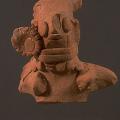
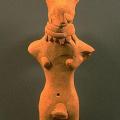
An unusual male figurine found at Harappa with a fan shaped headdress and choker around the neck may be a representation of alternative gender in the ancient Indus civilization. These are usually characteristic of female figurines. For more on Masculinity, see also Men of Harappa A, Men of Harappa B and Nude Male Figurine. For more on Femininity, see Women of Harappa A and Women of Harappa B. >

Possible Indus Crown

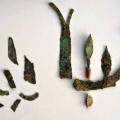
Not yet absolutely clear that this is an ancient Indus-style crown, but the chances are pretty good with find first reported in August. Reports on follow-up excavations in December by A.K. Pandey of the Archaeological Survey of India suggest it really could be from ancient Indus times, though final stratigraphy is awaited. The fact that the crown includes faience and carnelian, two typical ancient Indus precious materials, is promising. The August story can be found at Archaeology News Network. Read also the December report 4,000-Year-Old Copper Crown in India and a seal example of a … >

Harappan Sadhus and Fakirs?

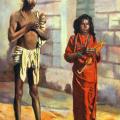
It is not unlikely that ascetics, both men and women who had renounced their possessions and lived off of the land or the generosity of donors, wandered about between the Indus towns and villages. In later periods there are textual references to similar ascetics associated with various religious traditions. In Hindu, Jain, Buddhist and Islamic/Sufi traditions, men and women, often in the later stages of life, renounced their possessions to focus on spiritual thought and service. >

Another Skeleton from Harappa

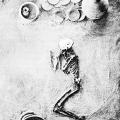
Another skeleton from Harappa, this from Marshall's excavations published in 1931. He writes: "At Harappa several examples of this mode of sepulture [complete inhumation], which are unquestionably orthodox, have already been exposed in the lower stratum of Cemetery H, and more are likely to come to view as the excavation progresses." See also Burials at Harappa and Painted Burial Pottery. >

A Story Tablet from Harappa

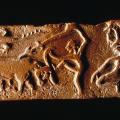
One side of a planoconvex molded tablet found in 1995 in Mound ET at Harappa. Mark Kenoyer writes about his narrative scene depicting the killing of a water buffalo: "A person, possibly a man, with hair tied in a bun on the back of the head, impales a water buffalo with a barbed spear. The hunter's foot presses down on the water buffalo's head as he thrusts the spear into its shoulder. In Later Hindu rituals, the water buffalo sacrifice is associated with the worship of the goddess Durga, but on this seal the sacrifice takes place in the presence of a priest or deity seated in yogic position… >

Indus River Fishing and Fishmongers: A Look Back

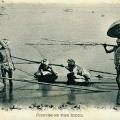
These postcards from the early 1900s and albumen photographs from the 1860s give us a glimpse into some of the fishing technologies and practices that were in use at the time. Combining information from multiple sources, including archival images and narratives, enables us to draw conclusions about what the material culture and social practices of the people of the Indus Valley might have been like. 1. The first postcard is from the early 1900s, probably around 1905 in Sindh Province. The fishermen are getting read to swim out into the water using a "boatless" technology which involves fl… >

Steatite Wig

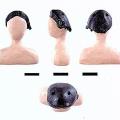
Black steatite wig from late Period 3C deposits in Trench 43 found at Harappa. This small stone hairpiece, here displayed on a modern clay mannequin, may have been set on an alabaster head like similar pieces found in western Pakistan, Afghanistan, and Southern Central Asia. >

Pagination

  • Page 1
  • Page 2
  • Page 3
  • Page 4
  • Page 5
  • Next page
  • Last page
Blog Posts by Subject (16)
  • Animals
  • Art
  • Children
  • City Life
  • Conferences
  • Crafts and Industry
  • Evolution
  • Excavations
  • Food
  • Homes
  • Media
  • Museums
  • Mysteries
  • News
  • People
  • Seals
© Harappa.com 1995-2026 31