Home

Main navigation

  • home
  • slides
  • essays
  • articles
  • books
  • video
  • q & a
  • blog
Secondary menu
  • about us
    • scholars
    • privacy
    • support
    • image rights
    • credits
    • contact us
  • resources

Mysteries

Mysteries and unsolved archaeological puzzles of the ancient Indus Valley Civilization.

Ritual Mask or Amulet

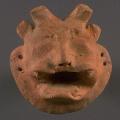
Loosely included under the rubric of terracotta "figurines" are the terracotta masks found at some Harappan sites. This mask clearly has a feline face with an open mouth with exposed fangs, a beard, small round ears and upright bovine horns. It is small and has two holes on each side of the face that would have allowed it to be attached to a puppet or worn, possibly as an amulet or as a symbolic mask. The combination of different animal features creates the effect of a fierce composite animal. As an amulet or a symbolic mask, it may represent the practice of magic or ritual transformation in … >

Unicorn Amulet Seal

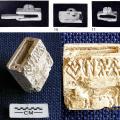
Only a few specimens of this unicorn amulet-type seal have been found. One was during Marshall's excavations at Mohenjo-daro in the 1920s (top), another at Dholavira a few years ago (bottom). It appears to have been worn around the neck, and have had room for something to be put inside. Although Marshall himself did not favor the amulet theory, he wrote of one of these seals: "The amulet theory finds some support, however, in the shape of ... [a] seal [which] measures 0.77 in. square and 0.3 in. thick, excluding its boss. The interior has been carefully hollowed out to form a compartment … >

Lothal Terracotta Dice and Game Board

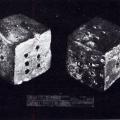
"Much valuable information about the various indoor games indulged in by the Harappans is available from the gamesmen, game-boards and dices found at the major Indus cities. A game involving the use of dice was very popular in the Harappan and later times, especially in the time of the Mahabharata war. The Pandava prince is said to have lost everything including his kingdom in a game of dice. An earlier reference to the games is contained in the Rgveda whcih mentions the use of Vibhitika wood for making dice. Lothal has yielded a cubical terracotta dice marked 1 opposite 2, 3 opposite 4, and … >

The Great Bath of Mohenjo-daro A

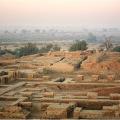
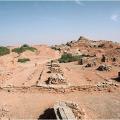
The great bath at Mohenjo-daro at dawn and in context. Surrounded by a brick colonnade, it measures approximately 12 meters north-south and 7 meters wide, with a maximum depth of 2.4 meters. In the background is a massive brick structure with narrow passages that was first identified as a hammam or hot-air bath, and later as the state "granary," but this is not certain. See also The Great Bath of Mohanjo-daro B. >

Possible Indus Crown

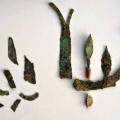
Not yet absolutely clear that this is an ancient Indus-style crown, but the chances are pretty good with find first reported in August. Reports on follow-up excavations in December by A.K. Pandey of the Archaeological Survey of India suggest it really could be from ancient Indus times, though final stratigraphy is awaited. The fact that the crown includes faience and carnelian, two typical ancient Indus precious materials, is promising. The August story can be found at Archaeology News Network. Read also the December report 4,000-Year-Old Copper Crown in India and a seal example of a … >

The Mysterious Pillared Hall in Mohenjo-daro

What was this enormous building in Mohenjo-daro used for? "The northern portion of Block 4 (Image 1)," in the L Area wrote the archaeologist John Marshall, "was originally a large hall of the Intermediate Period which appears to have been entirely covered ink the roof being supported by twenty rectangular piers averaging 5 feet by 3 ft. 4 in. in thickness." >

Mystery of the Pillared Hall

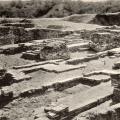
What was the large pillared hall at Mohenjo-daro used for? The hall was approximately 27.5 meters square (90 feet square) with twenty square brick pillars arranged in four rows, only two of which are still preserved. Strips of paved floors sloped from south to north and each strip of flooring had row of bricks set on edge along both sides. The cross wall in the foreground was built later and divided the hall into smaller rooms. Its purpose remains an enigma. >

What Were the Cones?

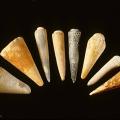
Decorated terra cotta cones are found at both Mohenjo-daro and Harappa, but no one knows what they may have been used for. Some scholars suggest that they were hung on a string as a plumb-bob for use by masons and carpenters. Others feel that they may have been toys or possibly used for writing. No traces of ink have been found on the tips, but many of the tips are worn smooth or chipped. What do you think they may have been used for? >

Dholavira and Its Mysterious Sign Board

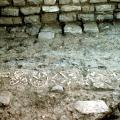
Dholavira is a Harappan site located in the Rann of Kutch, Gujarat. This 47 hectares (120 acres) quadrangular city is one of the largest mature Harappan sites. The site was occupied from ca. 2650 BCE, declining slowly after about 2100 BCE. >

Shell Bangle Workshop in Gola Dhoro

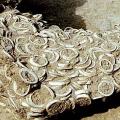
Why was this shell bangle workshop suddenly abandoned in Gola Dhoro, Gujarat? Great wealth was left behind. Archaeologist Kuldeep Bhan writes: "One of the most important craft activities pursued with great vigor at the site was the production of shell bangles from Turbinella pyrum. One of the fascinating discoveries associated with this craft was the recovery of a rectangular mud brick structure measuring approximately 5.60 x 3.20m with an adjoining chamber, situated on the northwestern periphery inside the fortification. Within this structure three large heaps of shell resting against the we… >

Pagination

  • Page 1
  • Page 2
  • Page 3
  • Page 4
  • Page 5
  • Next page
  • Last page
Blog Posts by Subject (16)
  • Animals
  • Art
  • Children
  • City Life
  • Conferences
  • Crafts and Industry
  • Evolution
  • Excavations
  • Food
  • Homes
  • Media
  • Museums
  • Mysteries
  • News
  • People
  • Seals
© Harappa.com 1995-2026 31