
The recent evidence from Mohenjo-daro of a "Kot Dijian" layer beneath its Indus ruins, including the city wall, dating from 2600 BCE or earlier, possibly 3300 BCE, brings renewed interest to the period of "regionalization" — when distinct local cultures across the Indus system were developing toward the urban integration of the Mature Harappan. This article on the first excavations in the mid-1950s at Kot Diji by the Pakistan Dept. of Archaeology is from The Illustrated London News of May 24, 1958. Kot Diji is less than 100 km away from Mohenjo-daro, and evidence for its distinctive pottery have been found in early layers at Harappa as well (700 km away); the earliest evidence for Kot Dijian culture dating to approximately 3300 BCE however comes from Rehman Dheri in Khyber Paktunkhwa, also hundreds of km away from Kot Diji. The "Kot Dijian" phase is thought to be the an early Harappan phase. Note that we call it "Kot Dijian" because the first evidence of the civilization was found there, not because its people (or was it peoples?) came from there or because it is the earliest known settlement of that culture, just as "Harappan" is often used to designate the Indus Civilization because it was the first known such site (this follows standard archaeological convention). In any case, new excavations are underway at Kot Diji today (2026), and there will no doubt we renewed interest and discoveries to be made in the coming years about the complex and varied environment from which what we know as Indus civilization emerged around 2600 BCE. Below is the verbatim article as it appeared in The Illustrated London News:
(The following article is based upon notes supplied by DR. FAZAL AHMAD KHAN, Director of Archeology to the Pakistan Government. It is a preliminary account of excavations recently carried out by that Department in a continued investigation of one of the earliest known civilisations, that of the Indus Valley of the third millennium B.C.)
In 1924 Sir John Marshall, then Director-General of Archaeology in India, announced in The Illustrated London News the discovery of a hitherto unrecognised civilisation in what was at that time North-Western India and is now Western Pakistan. The announcement was based on excavations then recently in progress at Harappa and Mohenjo-daro, in the Indus Valley, and the civilisation represented by those two large and remarkable city-sites was christened the Indus Valley Civilisation . With the familiar civilisations of Mesopotamia and Egypt, though somewhat later in origin, it at once took a distinguished place amongst the most ancient civilisations of the world. Indeed in geographical range it greatly exceeded its two contemporaries; for it stretched from the Himalayas to the Arabian Sea, a distance of 1000 miles, and more recent exploration has shown that it reached southwards to the Gulf of Cambay, with a coastline of some 800 miles. It represents a major achievement in the story of human progress.
The Indus Civilisation was certainly a going concern about 2500 B.C., but the manner of its foundation and early growth is still in large measure a mystery. On more than one of its principal sites a rising water-table has submerged its primary phases, and at the drier site of Harappa, in the Punjab, the great depth at which these phases lie has hitherto restricted investigation. But any light which can be thrown on the beginnings of a great civilisation is a substantial addition to knowledge, and the preliminary notes, just received from the Pakistan Department of Archaeology, on the excavation of a site which has some bearing on the problem, are well worthy of publicity.
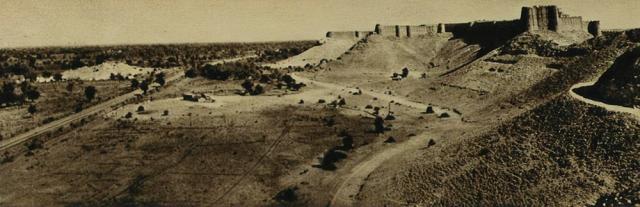
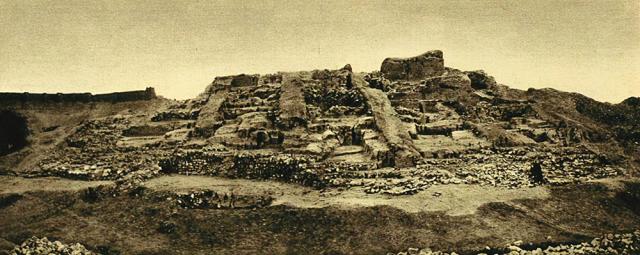
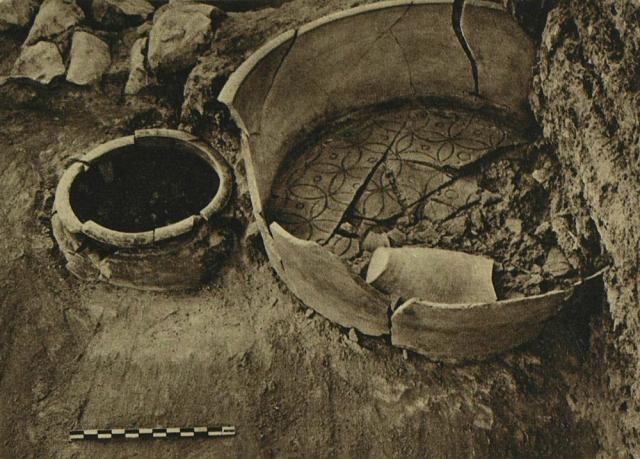
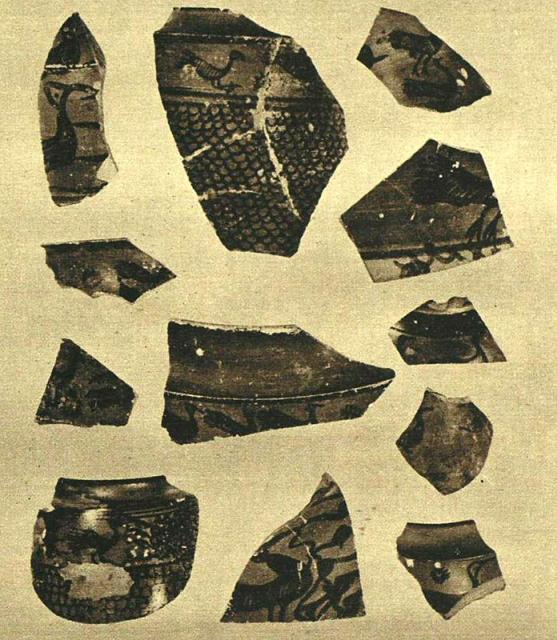
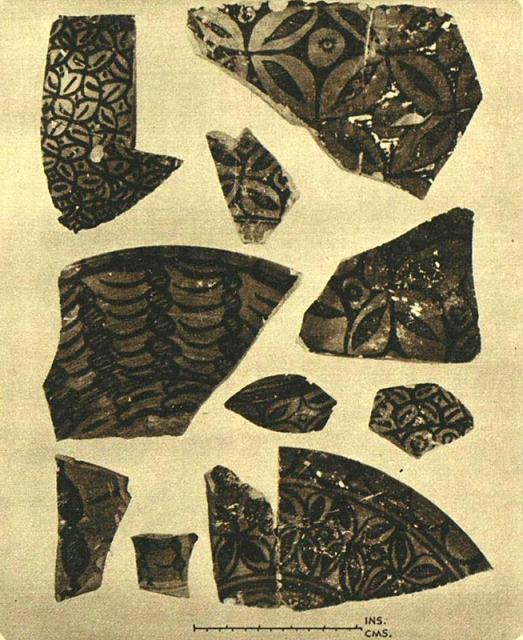
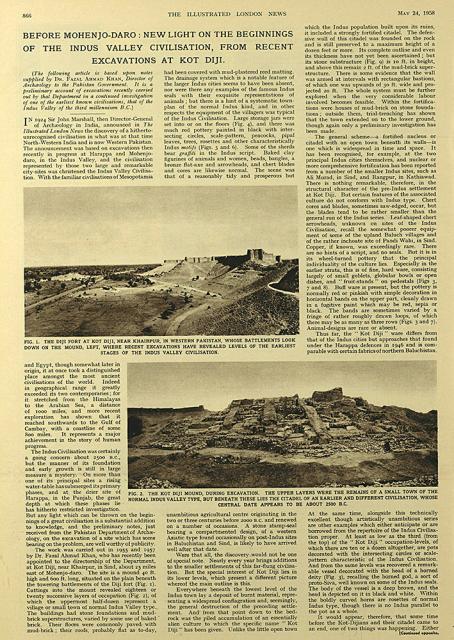
The work was carried out in 1955 and 1957 by Dr. Fazal Ahmad Khan, who has recently been appointed to the directorship of the Department, at Kot Diji, near Khairpur, in Sind, about 25 miles east of Mohenjo-daro. The site is a mound 40 ft. high and 600 ft. long, situated on the plain beneath the towering battlements of the Diji fort (Fig. 1). Cuttings into the mount revealed eighteen or twenty successive layers of occupation (Fig. 2), of which the uppermost half-dozen represent a village or small tow-n of normal Indus Valley type.. The buildings had stone foundations and mud- brick superstructures, varied by some use of baked brick. Their floors were commonly paved with mud-brick ; their roofs, probably flat as to-day, had been covered with mud-plastered reed matting. The drainage system which is a notable feature of the larger Indus cities seems to have been absent, nor were there any examples of the famous Indus seals with their exquisite representations of animals ; but there is a hint of a systematic town- plan of the normal Indus kind, and in other respects the equipment of the villagers was typical of the Indus Civilisation. Large storage jars were set into or on the floors (Fig. 4), and there was much red pottery painted in black with intersecting circles, scale-pattern, peacocks, pipal leaves, trees, rosettes and other characteristically Indus motifs (Figs. 5 and 6). Some of the sherds bear graffiti in the Indus script. Baked clay figurines of animals and women, beads, bangles, a bronze flat-axe and arrowheads, and chert blades and cores are likewise normal. The scene was that of a reasonably tidy and but unambitious agricultural centre originating in the two or three centuries before 2000 B.C. and renewed on a number of occasions. A stone stamp-seal bearing a compartmented design, of a western Asiatic type found occasionally on post-Indus sites in Baluchistan and Sind, is likely to have arrived well after that date.
Were that all, the discovery w'ould not be one of special note. Nearly every year brings additions to the smaller settlements of this far-flung civilisation. But the special interest of Kot Diji lies in its lower levels, which present a different picture whereof the main outline is this.
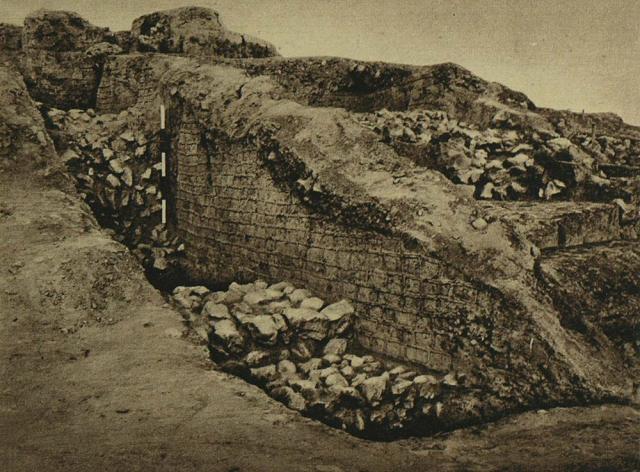
Everywhere beneath the lowest level of the Indus town lay a deposit of burnt material, representing a widespread conflagration and, seemingly, the general destruction of the preceding settlement. And from that point down to the bedrock was the piled accumulation of an essentially alien culture to which the specific name “Kot Diji” has been given. Unlike the little open town which the Indus population built upon its ruins, it included a strongly fortified citadel. The defensive wall of this citadel was founded on the rock and is still preserved to a maximum height of a dozen feet or more. Its complete outline and even its thickness have not yet been ascertained; but its stone substructure (Fig. 9) is 10 ft. in height, and above this remain 2 ft. of the mud-brick superstructure. There is some evidence that the wall was armed at intervals with rectangular bastions, of which one was upwards of 30 ft. wide and projected 20 ft. The whole system must be further explored when the very considerable labour involved becomes feasible. Within the fortifications were houses of mud-brick on stone foundations ; outside them, trial-trenching has shown that the town extended on to the lower ground, though again only a preliminary investigation has been made.
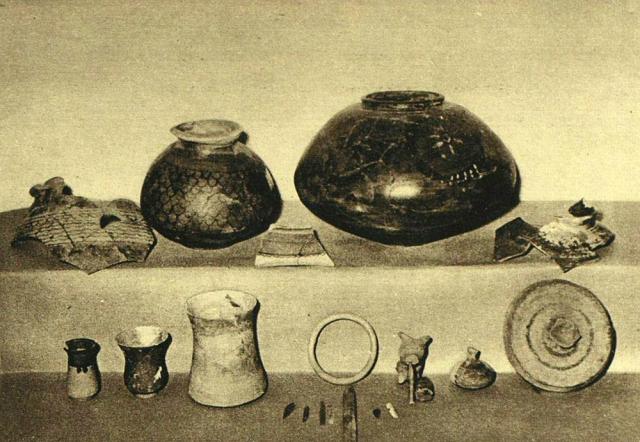
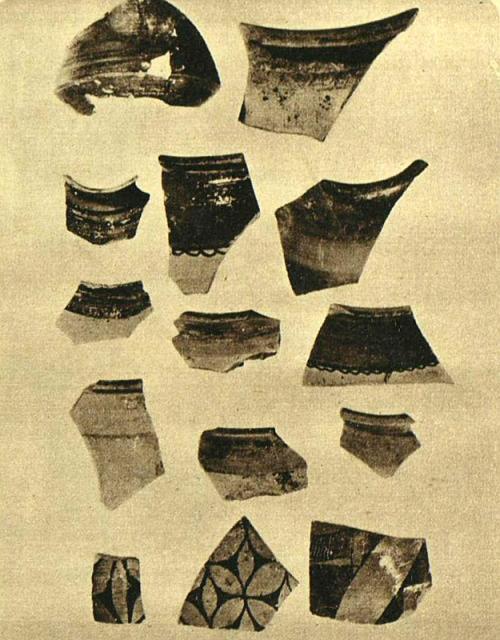
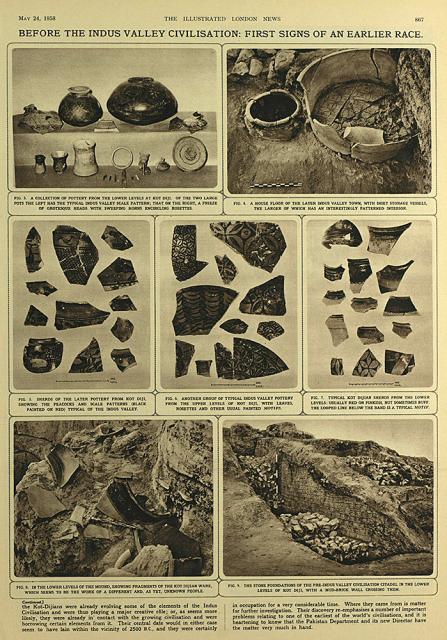
The general scheme—a fortified nucleus or citadel with an open town beneath its walls—is one which is widespread in time and space. It has been recognised, for example, at the two principal Indus cities themselves, and nuclear or more comprehensive fortification has been reported from a number of the smaller Indus sites, such as Ali Murad, in Sind, and Rangpur, in Kathiawad. There is nothing remarkable, therefore, in the structural character of the pre-Indus settlement at Kot Diji. But certain features of the associated culture do not conform with Indus type. Chert cores and blades, sometimes saw-edged, occur, but the blades tend to be rather smaller than the general run of the Indus series. Leaf-shaped chert arrowheads, unknown on sites of the Indus Civilisation, recall the somewhat poorer equipment of some of the upland Baluch villages and of the rather inchoate site of Pandi Wahi, in Sind. Copper, if known, was exceedingly rare. There are no hints of a script, and no seals. But it is in its wheel-turned pottery that the principal individuality of the culture lies. Especially in the earlier strata, this is of fine, hard ware, consisting largely of small goblets, globular bowls or open dishes, and “fruit-stands” on pedestals (Figs 3, 7 and 8). Buff ware is present, but the pottery is normally red or pinkish with simple decoration in horizontal bands on the upper part, cleanly drawn in a fugitive paint which may be red, sepia or black. The bands are sometimes varied by a fringe of rather roughly drawn loops, of which there may be as many as three rows (Figs. 3 and 7). Animal-designs are rare or absent.
Thus far, the “Kot Diji” ware differs from that of the Indus cities but approaches that found under the Harappa defences in 1946 and is comparable with certain fabrics of northern Baluchistan.
At the same time, alongside this technically excellent though artistically unambitious series are other examples which either anticipate or are borrowed from the repertoire of the Indus Civilisation proper. At least as low as the third (from the top) of the “Kot Diji” occupation-levels, of which there are ten or a dozen altogether, are pots decorated with the intersecting circles or scale- pattern characteristic of the Indus Civilisation. And from the same levels was recovered a remarkable vessel decorated with the head of a homed deity (Fig. 3), recalling the horned god, a sort of proto-Siva, well known on some of the Indus seals. The body of the vessel is a deep brown, and the head is depicted on it in black and white. Within the boldly curved horns are rosettes of normal Indus type, though there is no Indus parallel to the pot as a whole.
It would appear, therefore, that some time before the Kot-Dijians and their citadel came to an end, one of two things was happening. Either the Kot-Dijians were already evolving some of the elements of the Indus Civilisation and were thus playing a major creative role; or, as seems more likely, they were already in' contact with the growing civilisation and were borrowing certain elements from it. Their central date would in either case seem to have lain within the vicinity of 2500 B.C., and they were certainly in occupation for a very considerable time. Where they came from is matter for further investigation. Their discovery re-emphasises a number of important problems relating to one of the earliest of the world’s civilisations, and it is heartening to know that the Pakistan Department and its new Director have the matter very much in hand.
IMAGES
Fig. 1. THE KOT DIJI FORT AT KOT DIJI, NEAR KHAIRPUR, IN WESTERN PAKISTAN, WHOSE BATTLEMENTS LOOK DOWN ON THE MOUND, LEFT, WHERE RECENT EXCAVATIONS HAVE REVEALED LEVELS OF THE EARLIEST STAGES OF THE INDUS VALLEY CIVILISATION.
FIG 2. THE KOT DIJI MOUND, DURING EXCAVATION. THE UPPER LAYERS WERE THE REMAINS OF A SMALL TOWN OF THE NORMAL INDUS VALLEY TYPE, BUT BENEATH THESE LIES THE CITADEL OF AN EARLIER AND DIFFERENT CIVILISATION, WHOSE CENTRAL DATE APPEARS TO BE ABOUT 2500 B.C.
FIG. 3: A COLLECTION OF POTTERY FROM THE LOWER LEVELS AT KOT DIJI. OF THE TWO LARGE POTS THE LEFT HAS THE TYPICAL INDUS VALLEY SCALE PATTERN; THAT ON THE RIGHT, A FRIEZE OF GROTESQUE HEADS WITH SWEEPING HORNS ENCIRCLING ROSETTES.
FIg. 4: A HOUSE FLOOR OF THE LATER INDUS VALLEY TOWN, WITH INSET STORAGE VESSELS, THE LARGER OF WHICH HAS AN INTERESTINGLY PATTERNED INTERIOR.
FIG. 5: SHERDS OF THE LATER POTTERY FROM KOT DIJI, SHOWING THE PEACOCKS AND SCALE PATTERNS (BLACK PAINTED ON RED) TYPICAL OF THE INDUS VALLEY.
FIG. 6. ANOTHER GROUP OF TYPICAL INDUS VALLEY POTTERY FROM THE UPPER LEVELS OF KOT DIJI, WITH LEAVES,
ROSETTES AND OTHER USUAL PAINTED MOTIFS.
FIG. 7. TYPICAL KOT DIJIAN SHERDS FROM THE LOWER LEVELS: USUALLY RED OR PINKISH, BUT SOMETIMES BUFF. THE LOOPED LINE BELOW THE BAND IS A TYPICAL MOTIF.
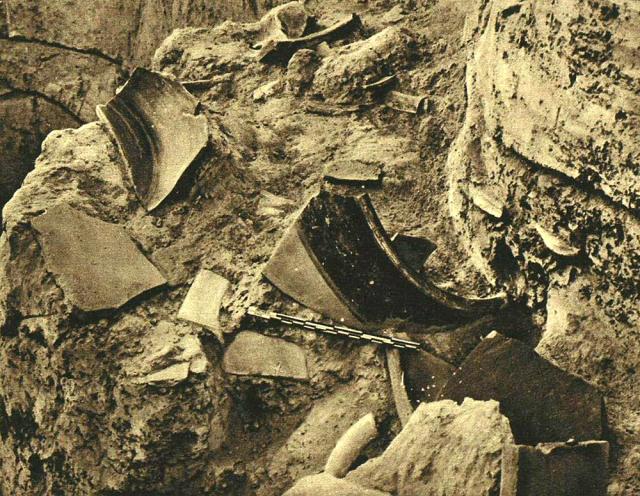
FIG. 8. IN THE LOWER LEVELS OF THE MOUND, SHOWING FRAGMENTS OF THE KOT DIJIAN WARE, WHICH SEEMS TO BE THE WORK OF A DIFFERENT AND, AS YET, UNKNOWN PEOPLE.
Fig. 9. THE STONE FOUNDATIONS OF THE PRE-INDUS VALLEY CIVILISATION CITADEL IN THE LOWER LEVELS OF KOT DIJI, WITH A MUD-BRICK WALL CROSSING THEM.