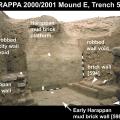
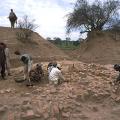
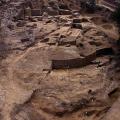
Lateral view of remnants of brick walls and massive mud brick platforms of the Harappan and Early Harappan (Kot Diji) Periods on the west side of Trench 54. Looking North. >
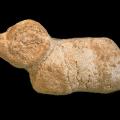
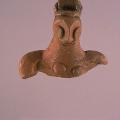
A small faience ram amulet recovered from the fill associated with the southwestern edge of the "granary" platform. (Trench 41SW, H97-3434/7650-01, Length = 21.8 mm) >
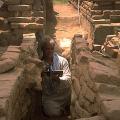
In addition to documentation with still photography, J. Mark Kenoyer videoed the "granary" areas excavated and narrated details of the stratigraphy and of the brick construction. >
Excavations in 1999 along the western of edge of Mound F (Trench 43) revealed fallen rubble from walls that had collapsed late in the Harappan occupation of this area of the site. Drummers standing on the piles of dirt left from earlier excavations … >
One of the falling walls in Trench 43 crushed a vessel that belongs to Harappa Period 4 (ca. 1900-1800/1700 BC). In this part of the mound, there appear to be transitional levels between the Harappan and Late Harappan periods. >
The northern end of Mound AB, shown here from the North, comprises more than 17 meters of occupational debris beginning on top of an old levee of the river Ravi and continuing up from the Ravi [Aspect of the Hakra] phase (Period 1 from before 3300 t… >
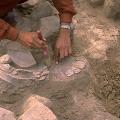
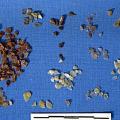
After wet screening, the Ravi phase microdebitage, larger flakes, broken drills, and even microbeads are sorted according to type of artifact and kind and color of stone. >
During the Kot Diji phase many new types of raw material were brought to Harappa for making ornaments and tools, indicating expanded trade networks and suggesting a growing population of consumers. A wide variety of stones reflecting different s… >