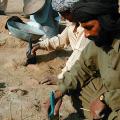
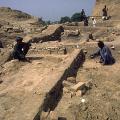
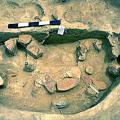
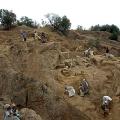
Mohammad Shamoon (black turban) and Abdul Sattar (flowered turban) are highly trained excavators who have worked with the Harappa project since 1986. Here they are carefully uncovering manufacturing debris in Trench 54 South. >
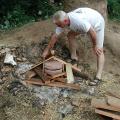
Experimental efforts to manufacture and fire faience and steatite tablets were undertaken by J. Mark Kenoyer in Madison, Wisconsin, during the summer of 2001. >
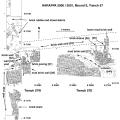
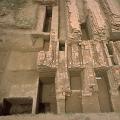
Deep digging at the southeast corner of the "granary" revealed an earlier building [wall 330] constructed along the same east-west alignment. This structure could have been built as early as the beginning of Period 3B, ca. 2450 BC. The currently vis… >
Unique cylindrical object made of maroon and white faience from Harappa (H99-3856/8756-26 from Trench 43, length = 21.9 mm). Numerous examples of this identical type of bead have been found in other parts of Harappa, but this may have been where the… >
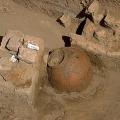
Pakistani excavators working in Trench 43. The man on the right has just discovered a spherical agate weight (image 68) while cleaning the section for photography. >
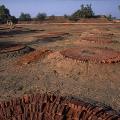
Circular platforms in the southwestern part of Mound F excavated by M.S. Vats in the 1920s and 1930s, as conserved by the Department of Archaeology and Museums, Government of Pakistan. >
This large Ravi phase pit was filled with domestic trash and some bead making debris. The broken amazonite bead in (8) can be seen just above the scale inside the pit to the lower right of the image. >
Harappa Mound AB, Trench 39N, showing the Kot Diji phase (Period 2, ca. 2800-2600 BC) and later levels during excavation. The surveying tripod is standing next to two Kot Diji phase kilns, and the rod is leaning against a later Harappa phase baked b… >