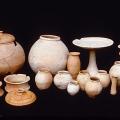
Collection of burial pottery without any painted designs. These vessels come from one of the later burials towards the end of the Harappan period, possibly dating to 1900 B. C. >
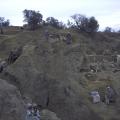
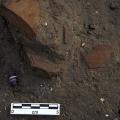
Excavations on Mound AB in 1998 began with the clearance of surface debris to expose the many habitation levels, beginning with natural soil in the lower foreground. This view shows almost 1700 years of superimposed occupation levels beginning aroun… >
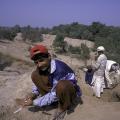
The discovery of a button seal is always exciting. Mushtaq, one of the excavation assistants from Harappa Town is proud to have found the second seal of the 1998 excavation season. >
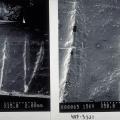
Scanning Electron Microscope analysis of the incising marks on the steatite tablets indicates the use of three different specialized bronze graving tools (see 58). Each tablet was first shaped from raw unfired steatite and then incised with the scr… >
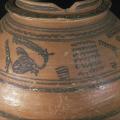
Late Harappan Period large burial urn with ledged rim for holding a bowl-shaped lid. The painted panel around the shoulder of the vessel depicts flying peacocks with sun or star motifs and wavy lines that may represent water. Cemetery H period, afte… >
The earliest settlement, during Period 1 (c. 3300-2800 BC), was on the west side of Mound AB and NW corner of Mound E. During Period 2 (c. 2800-2600 BC) all of Mounds AB and E came to be occupied, and by the end of Period 3 (c. 2600-1900 BC), the Ha… >
A banded agate bead (at left), a long terra cotta bead (center) and a cylindrical steatite bead (at right) were all found in the deposits of a room in Trench 54. >
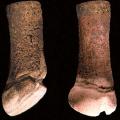
Tiny cloven hoof made of two-color faience probably from a composite figurine. This cloven hoof could represent any number of animals, but the most common in the Harappan artistic repertoire are cattle and water buffalo (H2000-4440/2121-90, Mound E,… >