
Home

Main navigation

  • home
  • slides
  • essays
  • articles
  • books
  • video
  • q & a
  • blog
Secondary menu
  • about us
    • scholars
    • privacy
    • support
    • image rights
    • credits
    • contact us
  • resources

First Street, Mohenjo-daro

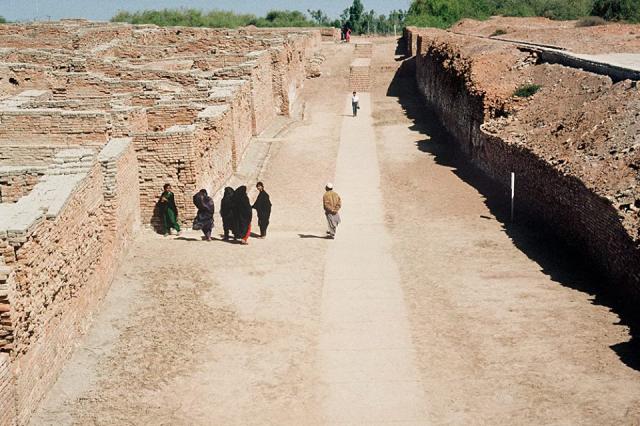
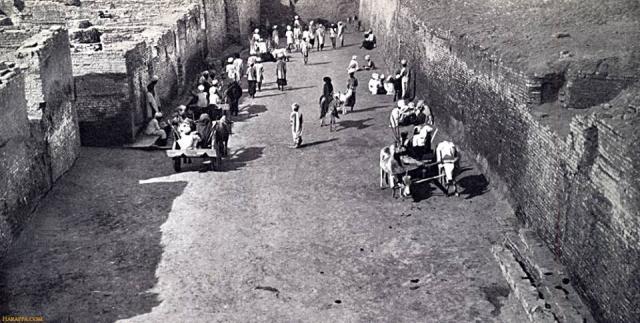
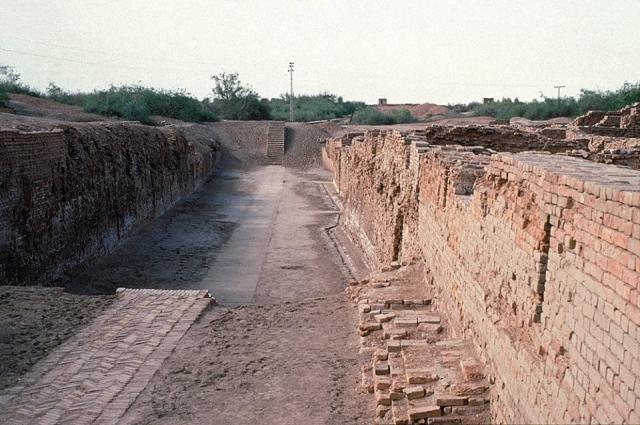
  • Looking north along First Street, Mohenjo-daro. "Only the facades of the eastern side of the street have been cleared, this being the limits decided upon for our excavations in this direction. Beyond this line, two-thirds of the mound, still remains untouched and will undoubtedly provide many buildings of interest for future excavations." (Mohenjo-daro, 1938, I, p. 25). The area to the left has been fully excavated and the area to the right is un-excavated. Later street levels are seen in the background. "That portion of First Street that runs alongside Blocks 3,5 and 6 has been excavated down to the foundation level of the Intermediate III occupation, at which level the width of the street varies from 32ft at the southern end to 30ft 3 ins at the north end of the section cleared... None the less, First Street was wide enough to take several of the vehicles of those days abreast. The scene in Plate XXIV, a, was arranged and photographed expressly to demonstrate this fact,"(MackKay, Mohenjo-daro,1938,I,p25) "In the Intermediate III Phase, FIrst Street was drained along the western side by a channel which may have been an open one. This drain, which averages 10 ins. wide by 1 ft. 11 ins. deep though well made was not very well aligned. It makes a bend where Block 6 enroaches on the street, and near the southern end of the section cleared it crossed the street and proceeded douthward on the opposite side." (Mohenjo-daro, 1938, I, p. 26). Looking down is going back in time, what you see on top are later sections now gone. On the LEFT side: First Street, Intermediate Levels I-III,From North. RIGHT side: First Street, Intermediate Levels I-III, From South.
    Looking north along First Street, Mohenjo-daro. "Only the facades of the eastern side of the street have been cleared, this being the limits decided upon for our excavations in this direction. Beyond this line, two-thirds of the mound, still remains untouched and will undoubtedly provide many buildings of interest for future excavations." (Mohenjo-daro, 1938, I, p. 25). The area to the left has been fully excavated and the area to the right is un-excavated. Later street levels are seen in the background. "That portion of First Street that runs alongside Blocks 3,5 and 6 has been excavated down to the foundation level of the Intermediate III occupation, at which level the width of the street varies from 32ft at the southern end to 30ft 3 ins at the north end of the section cleared... None the less, First Street was wide enough to take several of the vehicles of those days abreast. The scene in Plate XXIV, a, was arranged and photographed expressly to demonstrate this fact,"(MackKay, Mohenjo-daro,1938,I,p25) "In the Intermediate III Phase, FIrst Street was drained along the western side by a channel which may have been an open one. This drain, which averages 10 ins. wide by 1 ft. 11 ins. deep though well made was not very well aligned. It makes a bend where Block 6 enroaches on the street, and near the southern end of the section cleared it crossed the street and proceeded douthward on the opposite side." (Mohenjo-daro, 1938, I, p. 26). Looking down is going back in time, what you see on top are later sections now gone. On the LEFT side: First Street, Intermediate Levels I-III,From North. RIGHT side: First Street, Intermediate Levels I-III, From South.

Ernest Mackay writes (1938) "As far as we can tell at present, this street appears to be the second most important thoroughfare of the city; for although it is longer than the street that crosses it at right angles, coming presumably from the east gate of the city, the latter [First Street] is undoubtedly wider-along it, the grass-covered road to the camp now runs between the HR and VS Areas."

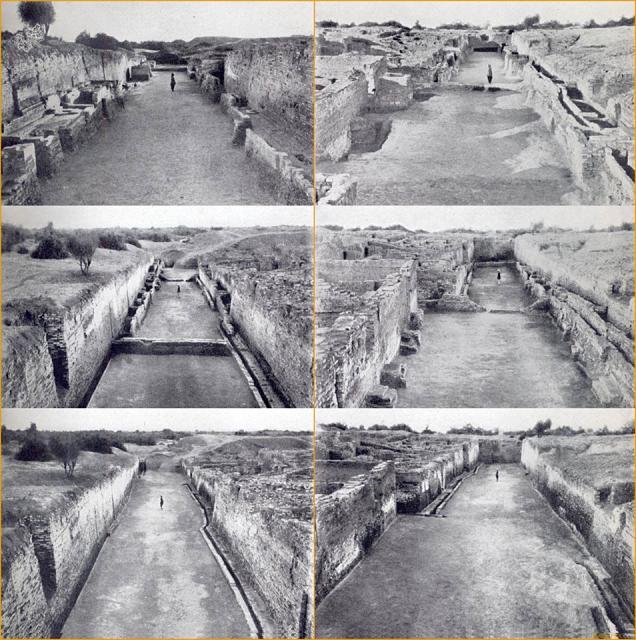
The fourth image shows the layers of excavation on this street, looking into the past. MackKay continues "the general impression that they make upon the eye and mind is that the masonry [stonework] is much better at the lower levels, save where a certain amount of patching was necessitated by floods and the action of salt." (Mohenjo-daro, 1938, I, p. 26).

MacKay writes of the center images "In general, First Street presented very much the same appearance in the Intermediate II Phase as in the previous sub-period, except that for a distance of 124 feet along the frontages of Block 5 and a portion of Block 6, platforms were built out into the street an average width of 4 ft. 6 ins. The outer faces of these structures were only one brick thick, the spaces between them and the houses behind them filled in with debris. There can be no doubt that on these benches the miscellaneous wares of a bazaar were set out for sale. . . . they appear to be of a considerable height, the explanation being that with the rise of the level of the street, the bazaar platforms had also to be raised, while the alignment of the street remained the same well into the Intermediate I Phase," (Mackay, Further Excavations at Mohenjo-daro, I, p. 27).

See also The First Street of Mohenjo-daro: Revisited.

Evolution

Blog Posts by Subject (16)
  • Animals
  • Art
  • Children
  • City Life
  • Conferences
  • Crafts and Industry
  • Evolution
  • Excavations
  • Food
  • Homes
  • Media
  • Museums
  • Mysteries
  • News
  • People
  • Seals
© Harappa.com 1995-2026 31