
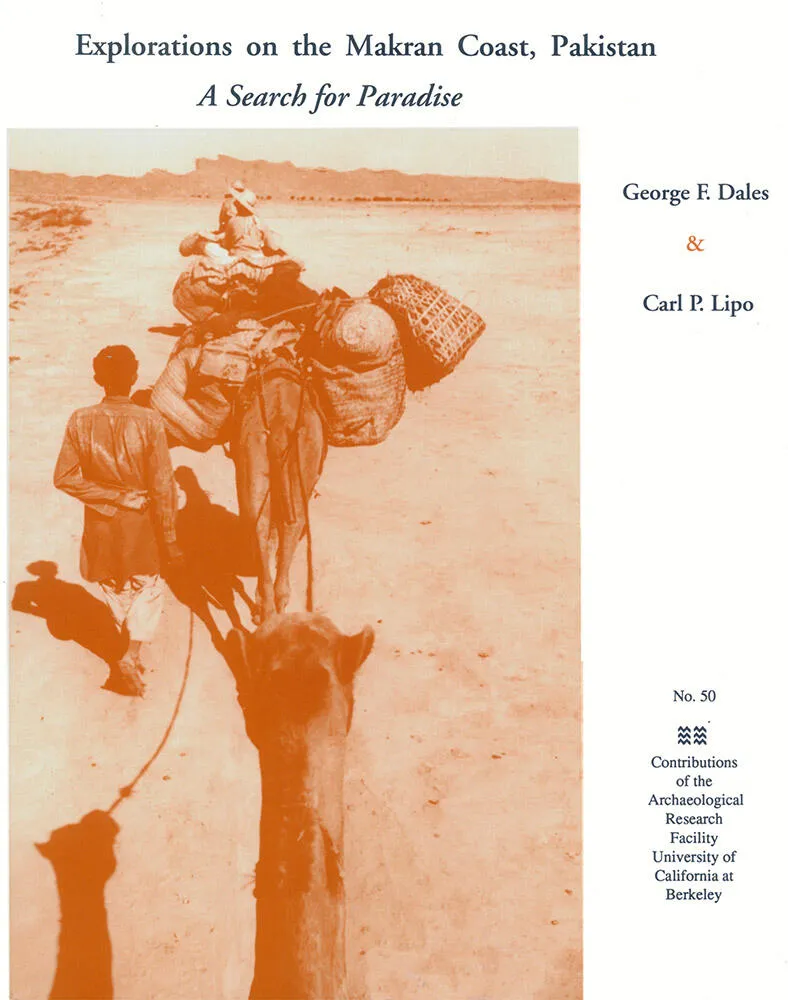
Subtitled A Search for Paradise, this is an unusual book, a combination of two types of work usually not brought into harmony. One is the record of a trip along the Makran coast of Baluchistan when Pakistan was a new country with a fledgling archaeology department splintered from the Archaeological Survey of India. The second is the excavation record of a trial trenches and examinations at Sutkagen Dor, the westernmost known ancient Indus site on the border between Iran and Pakistan. There is the discovery of another ancient Indus site, Sotka Koh, in the narrative as well. It is somewhat similar in its size and remnants of fortified walls to Indus sites discovered in recent decades in Gujarat, to the southeast of Baluchistan and Sindh.
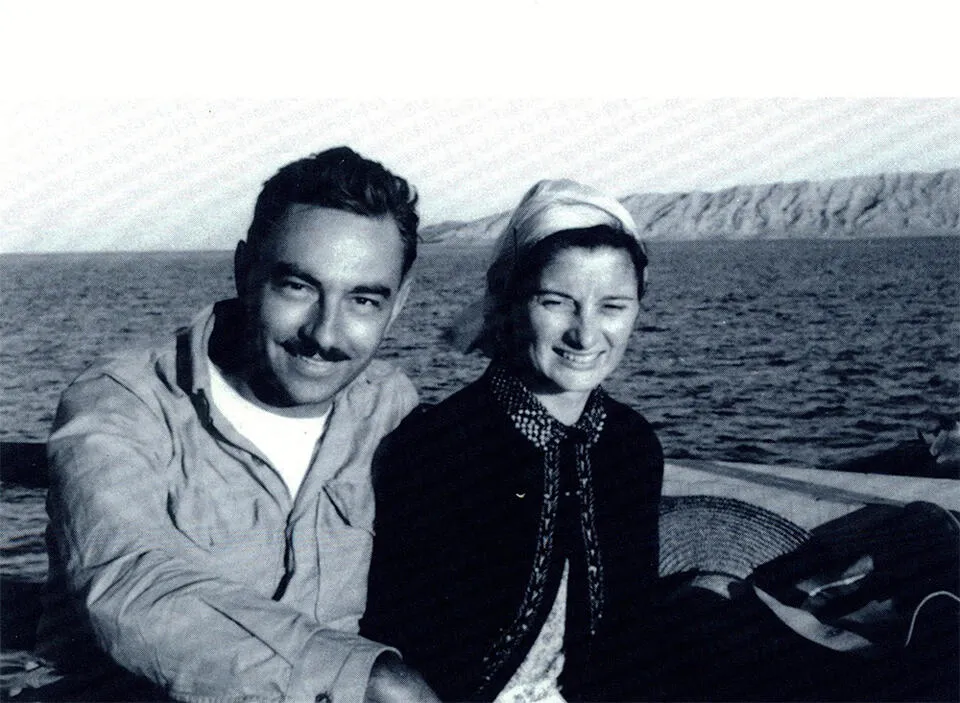
The author is George F. Dales who traveled with his wife Barbara [Image 2], creating a lot of interesting situations along the way in sparsely populated towns like Gwadar and Pasni. Dales, one of the founders of the Harappa Archaeological Research Project (HARP) and mentor to Dr. Jonathan Mark Kenoyer, is an engaging writer, keenly observant on one of his first archaeological field research trips. His way is smoothed by a number of Pakistani colleagues, including the young and promising Dr. Rafique Mughal. His descriptions also bring to life a lost world or archaeological personalities and politics, when a few hundred pounds in a grant could make a big difference, relationships were critical and mobility challenges great. It is a pleasure to read, and free!
"My budget was minimal and I sought out an ancient hotel, the Central Hotel, across the street from the 'first-class' Metropole Hotel," writes Dales. "Even there I could afford only the cheapest room which turned out to be an eight by ten foot "cell" at the end of the alley next to the main building. A naked, fly-specked bulb lit the dirt-streaked, whitewashed walls, the small cot, and single chair. An electric ceiling fan stirred about the flies and mosquitoes. Adjacent to the room was a tiny wash/toilet room equipped with one of those insidious pull-chain British toilets operable only by those whose lineage dates back at least to the time of Queen Victoria. But, a room with three meals per day for the equivalent of $3.78 a day was nothing to complain about. I had only $35.00 left in my pockets. Fortunately, the $1,000 promised by the University Museum was awaiting meat American Express the next day."
There are vivid descriptions of a country-in-the-making like the refugee camps in Karachi. Balochistan where he and his team (which included co-author and American anthropologist Carl P. Lipo and Mughal, later a distinguished Pakistani archaeologist), seems like another continent. Some areas are only linked through weekly rickety boat rides from Karachi and other ports. The active mud-volcanoes at Ormara, still the sites of regular Hindu pilgrimages, are described long before they became the more popular tourist sites of today. The waits for NOCs from various government agencies, the bureaucratic tentacles that reach as far as ports like Gwadar 500 kilometers away (home to a centuries-old Portuguese fort), remind the reader how much archaeology in the field is a negotiation between numerous power centers that go way beyond the people living in the area. At the same time, there is something refreshing in reading about discovery without the chatter of constant communication that researchers are usually subject to today.
The book maps a chain of coastal and near‑coastal sites (including smaller shell middens and occupation mounds) that show how the whole Makran coast along Balochistan facing the Arabian Sea was integrated into wider Indus and post‑Indus networks. The coast was not an isolated backwater. Dales links site locations to palaeo‑shorelines, estuaries, and river mouths, arguing that shoreline change and harsh arid conditions strongly influenced where Harappan and later communities could sustain fishing, shell gathering, and trade activities. The theoretical quest for Dales journey, in fact, is to find links between ancient Mesopotamia and the Indus civilization, especially traces of trade.
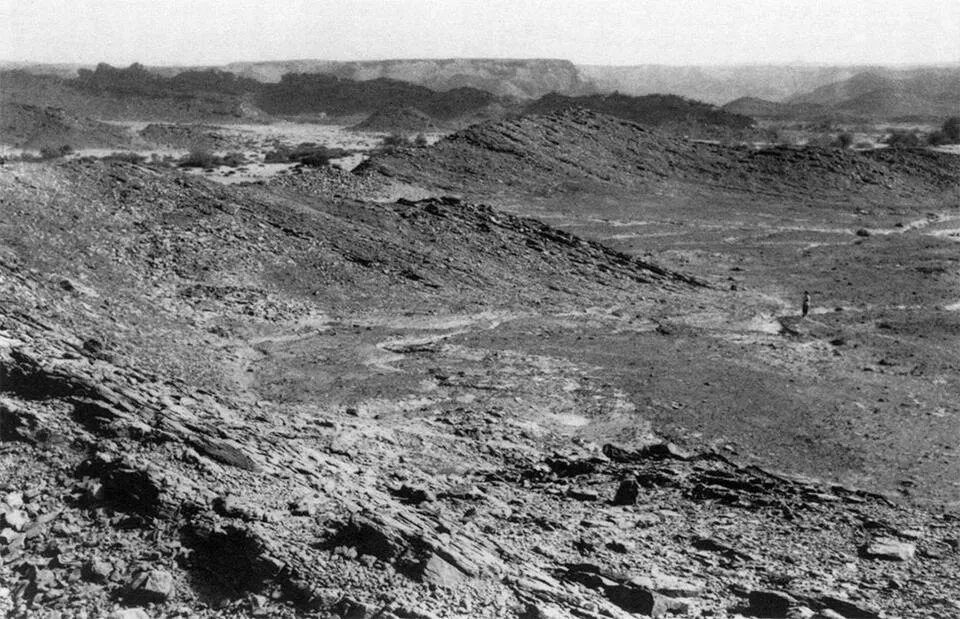
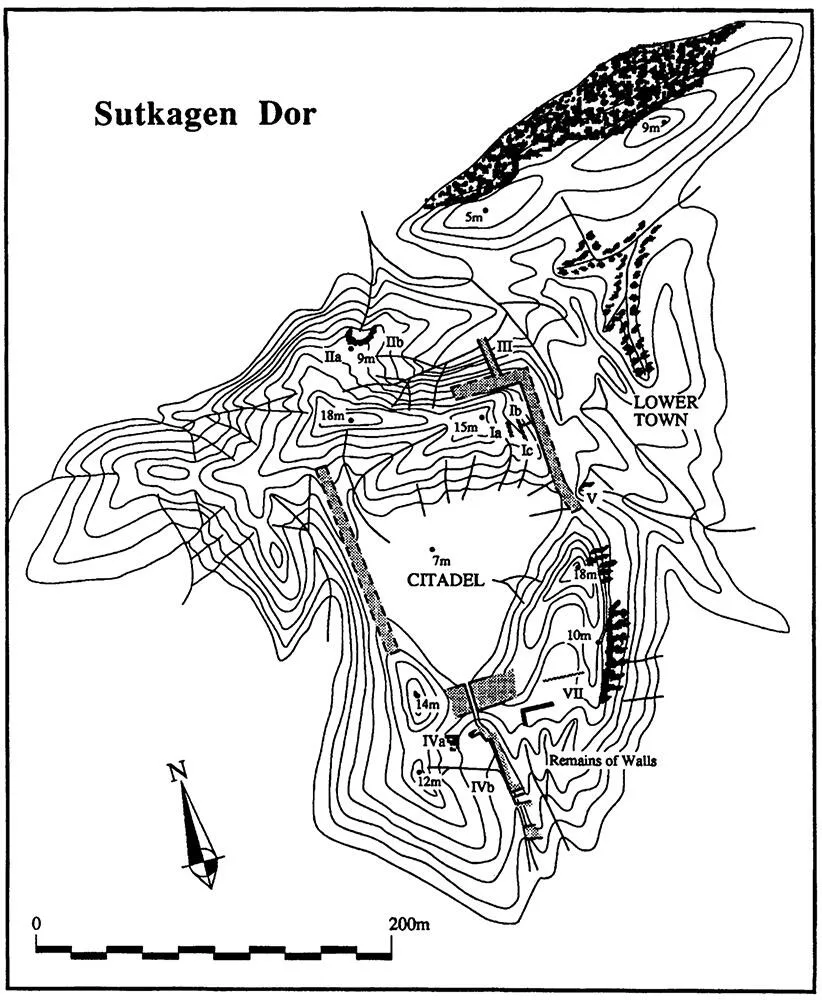
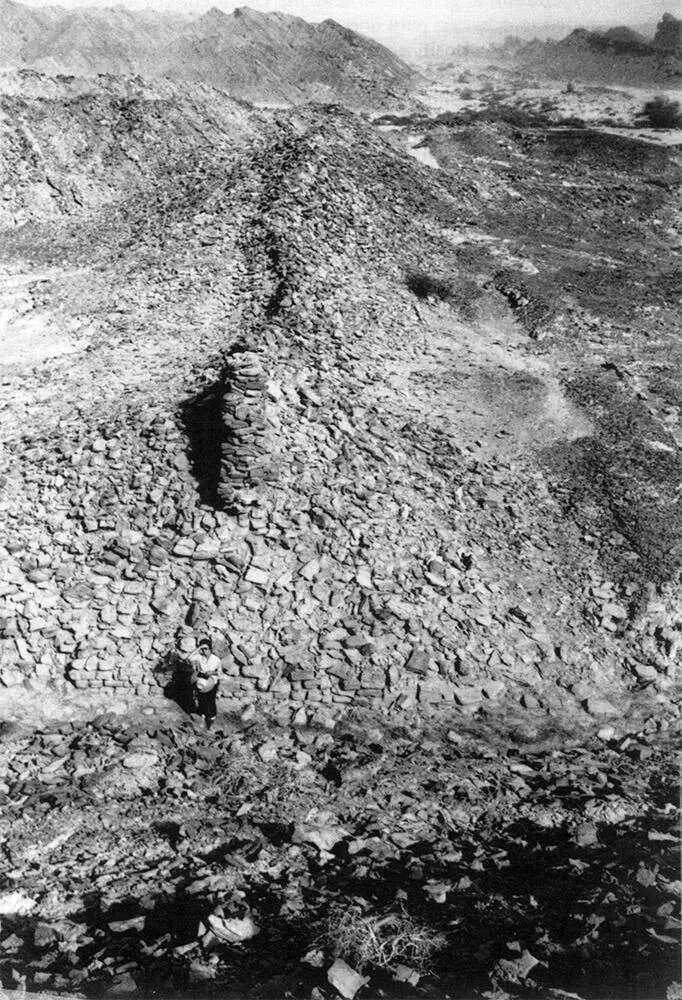
"Sutkagen Dor discovered in 1877 by Major E. Mockler, political officer in Gwadar. means the same as Sotka Koh, buried tepe/damb/mound," writes Dales (p. 102). Dales confirms Sutkagen Dor [Image 3, 4] as a fortified Harappan settlement at the far western edge of the Indus sphere, noting its stone citadel walls, lower town, gateway [Image 5, note how small Barbara Dales is standing in the opening] and position near an ancient lagoon or inlet that once connected to maritime routes. After the first 130 or so pages of travel, an equivalent section covers the excavations, really a few trenches (exceeding permits!) and detailed surface collections, with exemplary drawings of the pottery which ties Sutkagen Dor to various phases of Indus civilization. This well-illustrated section suggests strongly that the site was part of a trade network with Mesopotamia further on to the west across Iran.
Halfway between Karachi and Sutkagen Dor, Dales describes the highlight of their trip, finding with the help of locals, Sotka Koh (Sokhta Koh) near Pasni, a new Harappan coastal outpost: "We returned to the tahsildar's house again. He called in a few elderly local gentlemen. Mughal questioned them extensively. One of the men, Mir Ahmad Khan Kalmati, was head of the Kalmati tribe (some 1,000 people) that dominated the population of the area. He told us about five sites within six or seven miles to the north of Pasni. One of them, along the Shadi Kaur Valley, was covered with pottery that, according to his description, could be Harappan. The site even had a local Baluchi name-Sotkha Koh-equivalent in meaning to that of Sutkagen Dor, i.e., "burned tepe/damb/mound." We were excited at the prospect of making at least one major discovery of a Harappan site," (p. 102).
The site turns out to be be full of Mature Harappan ceramics, compound walls on a natural ridge, and evidence that it functioned as a utilitarian trading and provisioning station rather than a major urban center. No seals were found here (nor at Sutkagen Dor), which is interesting but with the amount of erosion at both places and lack of extensive excavations, it is hard to read too much into this fact. There seems to have been a massive wall at Sokta Koh too, which suggests that the traders need protection from people and/or water at the time.
By placing Sutkagen Dor and Sotka Koh along hypothesized coastal and overland routes between the Indus cities, the Persian Gulf, and Iranian plateau, Dales argues that the Makran coast formed a strategic corridor for seaborne and caravan trade. The cumulative archaeological evidence leads him to reinterpret Makran from a peripheral “desert fringe” into a structured frontier zone that extended Harappan economic reach and influenced later protohistoric developments in Kech‑Makran and adjacent regions. The significant work archaeological done in Balochistan in the decades since has only reinforced the importance of this region, not only as a thoroughfare for trade, but home to its own complex cultures that pre-date and probably contributed to but are also distinct from the later Indus civilization. Dale's and Lipo's engaging account is a fine human introduction to how this whole world of archaeological discovery and interpretation was slowly opened up to research and scholarship.
Images
1. Book cover
2. George and Barbara Dales off the Makran coast, 1960
3. Plan of SutkagenDor: updated from the original published by Aurel Stein (1931)
4. Sutkagen Dor: Inside the citadel, from northwest to southeast
5. Sutkagen Dor: Gateway at southwest corner of citadel; looking east along southern wall