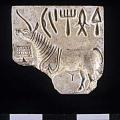
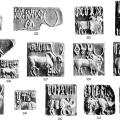
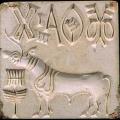
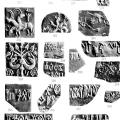
[Original 1931 text] We have certain proof in Nos 327-40 and Possibly No. 542, that this type of bull was known in India in very early times. The characteristic hump on the shoulders allows of no doubt whatsoever. Fortunately the majority of seals o… >
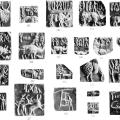
Published in ARASI 1924-25, Plate XXVIII, figs. 21, 22, 23 and 24. Title of Plate: ‘Seals and Other Objects’ Labelled, from left to right: “(24) Pit I 42”; “(21) Pit I 39”; “(22) Pit I 40”; “(23) Pit I 41”. Field no: 42, 39, 40 a… >
This type of seal is only found in the last part of the Harappan Phase, Period 3C. A similar rectangular seal was found on Mound F in the 1998 excavations of the circular platforms (Trench 43). >
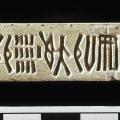
This seal from Mohenjo-daro measures 29 mm (1.14) inches on each side and is made of fired steatite. Steatite is an easily carved soft stone that becomes hard after firing. On the top are four "pictographs" of an as yet undeciphered Indus script, on… >
[Original 1931 text] This animal also rarely appears on the seals, Nos. 341-7 being the only examples that we have as yet. In every case it is the single horned animal that is represented, probably the great Indian rhinoceros which was formerly foun… >
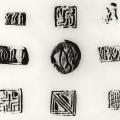
Nine seals: square, rectangular and oval. In three, the script can be clearly seen. The rest depict geometric motifs, of which one is described as svastika. Two published in Vats 1940: Plate XCV, nos. 396 and 400; Find numbers: AB 2545 and Ab 4… >
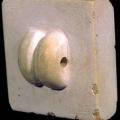
Mackay continues (p. 377 in Marshall 1931): "The boss was then carefully rounded off after the groove that always runs across its centre had been roughly made by a V-shaped cut. The rounding of the boss was apparently done with a knife and finish… >
[Original 1931 text] This animal is on fifteen of the seals, Nos. 362-76. In fact, it may be said to rank next in order of popularity to the bull. On most of the seals it is carefully portrayed, in some cases even to the wrinkles along its back. . … >