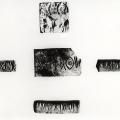
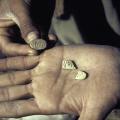
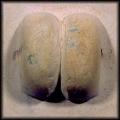
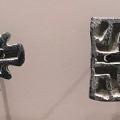
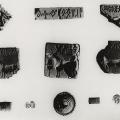
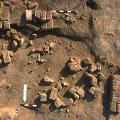
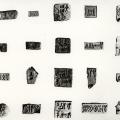
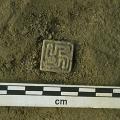
High concentrations of objects such as these terra cotta seal and faience tablets indicate the significance of this part of the site (Trench 54 area) for obtaining further insights on the manufacture and use of inscribed pieces. >
Mackay writes that most of the bosses on the backs of seals had the same size and shape. The perforation always runs in the direction of the animal's body, to help keep the seal upright when worn around the neck. The boss is centered on the back … >
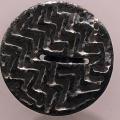
Compare the square seal on right with this button seal found at Harappa. These and the stone seals shown earlier are often called "compartmented" seals, with the backs being either open or closed. Sandro Salvatori in Bactria and Margiana Seals: … >
Published in ARASI 1924-25, Plate XXVIII. Title of plate: ‘Seals and Other Objects’ Four unicorn seals, a rhomboidal seal, and rectangular seals. The provenance for some provided in the object label quoted below. From left to rig… >
After removing the fallen walls, the interiors of the rooms were found to be filled with surprises. Here in Room 202 were scattered clay tops, beads, and inscribed seals (Trench 43). >
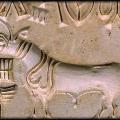
If the figure does represent a cattle species, the clearly carved collar, garland and necklace could help explain its function. Sacrificial animals in village India are often garlanded and decorated similarly today. The Rg Veda speaks of the capture… >
The wide variety of seals found at Mundigak, mainly stone but also some copper, have deep material and stylistic connections with Central Asia (see two bronze Mundigak seals), and, towards the south-east, with sites recently found in Iran from betwe… >
Seven unicorn seals, all but two broken, among other types. Top row Left: Published in ARASI 1924-25 Plate XXVII, No. 8, “A (b) 922” Third from Left: Published in ARASI 1924-25 Plate XXVII, No. 4, “A (i) 16” Fourth from Left:… >