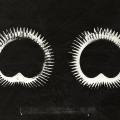
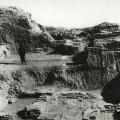
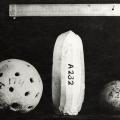
He continues, about perhaps one of the finest objects he found in 1921: "One pair of them attains a high degree of excellence. It is made of fine clay coloured blue. (No. A 182.) Plate IX, Photo No. 2759." - Daya Ram Sahni, Annual Progress Re…>
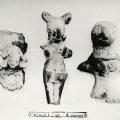
Three terracotta figurines, female. All broken. A field number ending in 708 is marked on the head-dress of the one on the left, of which only the bust remains. >
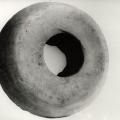
Round stone ring reclaimed from possession of Harappa Police Thana Published in Vats 1940, Vol. II, Plate CXVII, 3. Title of Plate “Miscellaneous Cult and Household Objects” Vats mentioned the find of this ring stone in relation to excavat… >
This photograph of a jar illustrated in the center of Trench A(e) (Vats 1947, Plate IX), shows the base of a large jar that was probably used as a latrine. There are two smaller vessels that were probably used for pouring water after using the toil… >
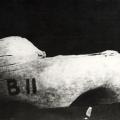
"Most of these fragments were, however, easily identified as parts of the undulating rings, three complete specimens of which are lying on the site. The precise purpose of these rings is not yet ascertainable, and I have not seen anything like them … >
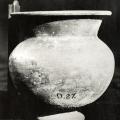
There are several photographs of the earthen jar D27 that was found on Mound A-B. This was one of the earliest complete pots discovered at Harappa. That this pot was one of the images published by Marshall in his announcement in the Illustrated Lond… >
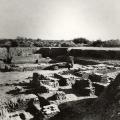
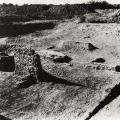
View of the parallel wall area, Mound F, noted subsequently by Vats as the eastern part of the Great Granary. For Sahni’s and Vats’s description of the excavations of this area see Parallel Walls. See Plate III Vats 1940 Vol II for a ‘Plan of … >
"Balls in terracotta, stone, shell, and faience have been found universally at Harappa, those in terracotta being recovered in specially large numbers." >