Home

Main navigation

  • home
  • slides
  • essays
  • articles
  • books
  • video
  • q & a
  • blog
Secondary menu
  • about us
    • scholars
    • privacy
    • support
    • image rights
    • credits
    • contact us
  • resources

Visits to ancient Indus objects in museums on three continents.

Four Seals Up Close

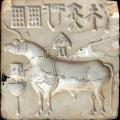
A visit to the National Museum of Pakistan in Karachi gave me the opportunity to take close shots of four seals from Mohenjo-daro. They show both the exquisite workmanship of Indus craftsmen and the merciless wear, in different degrees, of four thousand years of history. >

The Musee Guimet Indus and Amri Collection in Paris

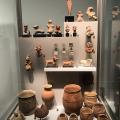
In the summer of 2019, one of the warmest ever in Paris, I managed to slip one afternoon into the Musee Guimet, and click away on my iPhone at objects usually not seen in colour. This French national museum which contains one of the best collections of Asian Art in the world (as one collector of Indian art, Gursharan Sidhu once put it, the French taste in objects from India is second to none). >

Mundigak at the Guimet, Paris

A brand new slide show has just been opened featuring objects from Mundigak, a little-known Bronze Age [c. 4000-2400 BCE] set of mounds in southern Afghanistan. The objects are now at the Guimet, the French National Museum of Asian Art in Paris. Their similarity to objects and motifs in the ancient Indus Valley is remarkable. Examples include the pipal leaf, a rat trap, the humped bull, a bird whistle and classic goblets the Mundigak excavators called "brandy balloons." There is even a stone sculpture which resembles the "priest-king." This 33 slide section Mundigak @ the Guimet is accompa… >

Ram @ Guimet

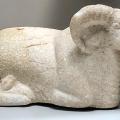
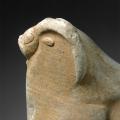
"The abundance of animal figurines at the major [Indus] urban centers suggests that they were commonly used in household and public rituals," writes Mark Kenoyer (Ancient Cities, p. 118). "All major domestic and wild animals are represented by terracotta figurines, but only a few animals were made in stone or faience. Two fragmentary stone sculptures of a seated ram were recovered from excavations at Mohenjo-daro," he continues; one was a faience amulet with a hole drilled through it, and there was also a larger sandstone of a seated ram [Image 3]. Ernest Mackay too noted how "model anima… >

Queen Puabi of Ur's Burial Shroud

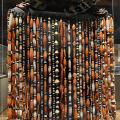
It is ironic that what is possibly one of the most spectacular examples of Indus craftsmanship and artistry was found not at Mohenjo-daro or Harappa, or even in the subcontinent, but in ancient Mesopotamia. >

Around the Indus in Pakistan

Recent news includes the opening of a Rediscovering Harappa: through the five elements (water, earth, fire, air, ether) Exhibition at the Lahore Museum on November 21st, and the apparent discovery of Indus artifacts from 2600 BCE in Sikander South near Dera Ismail Khan. >

Chanhu-daro in Boston

The Museum of Fine Arts (MoFA) in Boston, USA has the largest collection of Indus artifacts outside India and Pakistan. MoFA collaborated with the American School of Indic and Iranian Studies in 1935-36 to excavate Chanhu-daro in Sindh, Pakistan, then British India. This mysterious, small and sophisticated craft manufacturing town about 80 miles south of Mohenjo-daro was discovered by N. G. Majumdar in 1931. He and the leader of the Chanhu-daro excavations Ernest J.H. Mackay had both worked at Mohenjo-daro earlier in the decade, so one can only imagine how thrilled they were to find another p… >

A Visit to the Metropolitan's Indus Collection

On a recent trip to New York, I was able to get away for an afternoon to explore the ancient Indus collection at that battleship of a museum, the Metropolitan Museum of Art. I found the Indus collection split between two rooms, 234 in the Asian Art and 403 in the Ancient Near Eastern Art sections, with a nice long walk in between. >

The Great Jar of Chanhu-daro

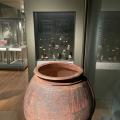
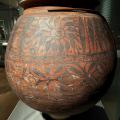
"Jar painted with birds. 2600-1900 BC, Terracotta with red slip and black painted decoration," is what the unvarnished description at the Museum of Fine Arts (MoFA), Boston reads; in truth this is one of the largest and most richly painted ancient Indus pots ever found. >

A Carnelian Feast at the British Museum

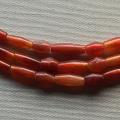
On a recent visit to London, I decided to have another look at the British Museum's handful of Indus objects. They are usually displayed – with little celebration, given their importance, like the first seal ever found at Harappa . . . >

Pagination

  • Page 1
  • Page 2
  • Page 3
  • Next page
  • Last page
Blog Posts by Subject (16)
  • Animals
  • Art
  • Children
  • City Life
  • Conferences
  • Crafts and Industry
  • Evolution
  • Excavations
  • Food
  • Homes
  • Media
  • Museums
  • Mysteries
  • News
  • People
  • Seals
© Harappa.com 1995-2026 31